 ChipApex | Global Electronic Components Supplier
SEARCH
Search Product
Search Post
— IC芯片 | 连接器 | 传感器 | 被动器件 —
Search productSearch post
— IC芯片 | 连接器 | 传感器 | 被动器件 —
Consult the customer manager about the wholesale price.
consultation hotline:86-132-6715-2157
email:[email protected]
Contact the product manager for consultation. One-stop consultation is available.
Do you want a lower wholesale price? Please send us your inquiry and we will reply immediately.
The UMC5NQ-7 is a dual complementary pre-biased transistor array from Diodes Incorporated, featuring one NPN and one PNP bipolar junction transistor within an SOT-353 surface-mount package. It integrates internal base resistors (R1: 47 kΩ for NPN, 4.7 kΩ for PNP) to simplify circuit design. The device supports a maximum collector current of 100 mA and operates up to a transition frequency of 250 MHz. Qualified to AEC-Q101 standards, it functions across a temperature range of -55°C to +150°C with a power dissipation rating of 290 mW.
Verify the specific ordering suffix matches the required reel size and quantity per reel. Confirm that the marking code corresponds to the intended production date code. Ensure compliance with RoHS 2 and REACH directives if applicable to the target market. Check for PPAP capability requirements if sourcing for automotive assembly lines.
Select this component when a complementary pair of pre-biased transistors is needed in a minimal footprint. Verify that the integrated resistor values (47 kΩ and 4.7 kΩ) align with the input drive requirements. Ensure the operating voltage and current limits accommodate the specific load conditions without exceeding the 290 mW power dissipation rating.
This part belongs to the UMC5 series of dual complementary pre-biased transistors produced by Diodes Incorporated. It utilizes the SOT-353 case style, which is standardized for small surface-mount applications. The product line is designed to replace discrete resistor-transistor combinations in digital logic interfaces.
Direct substitutes must match the SOT-353 package and contain both NPN and PNP pre-biased elements. Verify that any alternative part meets the same AEC-Q101 qualification level and maintains comparable electrical characteristics for transition frequency and saturation voltage.
The NPN section (Q1) has an internal base resistor (R1) of 47 kΩ, while the PNP section (Q2) has an internal base resistor (R1) of 4.7 kΩ.
Yes, the UMC5NQ-7 is qualified to AEC-Q101 standards and is PPAP capable, making it suitable for automotive electronics.
The maximum power dissipation (PD) is 290 mW when mounted on an FR-4 PCB according to the suggested pad layout.
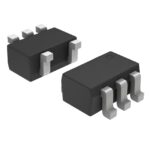 UMC5NQ-7
The activity of extra discounts on wholesale prices is in full swing…
Please fill in your contact information and we will send you the latest wholesale price list.




