ChipApex | Global Electronic Components Supplier
SEARCH
Search Product
Search Post
— IC芯片 | 连接器 | 传感器 | 被动器件 —
Search productSearch post
— IC芯片 | 连接器 | 传感器 | 被动器件 —
Consult the customer manager about the wholesale price.
consultation hotline:86-132-6715-2157
email:[email protected]
Contact the product manager for consultation. One-stop consultation is available.
Do you want a lower wholesale price? Please send us your inquiry and we will reply immediately.
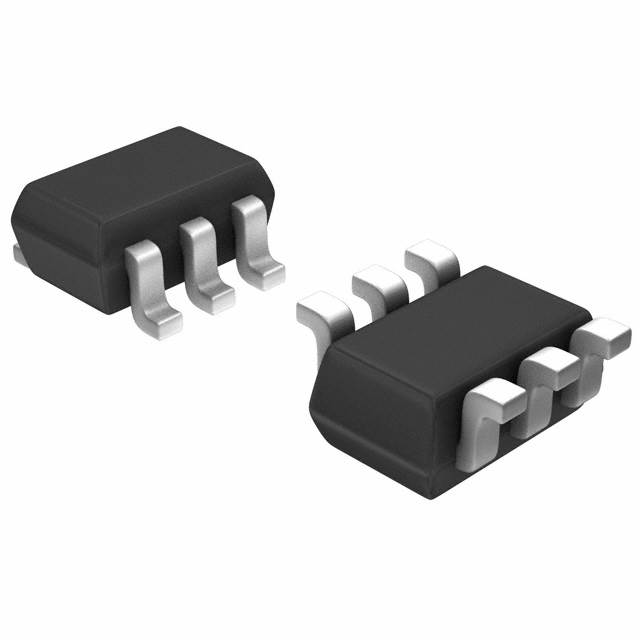
The UMD25NTR is a dual digital transistor from ROHM Semiconductor, integrating one NPN and one PNP pre-biased transistor within a compact SOT-363 (UMT6) surface-mount package. It features a typical input resistance of 2.2 kOhms and an emitter-base resistance of 47 kOhms for both polarities. The device supports a maximum collector-emitter voltage of 50V and a continuous collector current of 100mA. Key electrical parameters include a DC current gain (hFE) minimum of 80 at 10 mA/5V, a transition frequency of 250 MHz, and a power dissipation rating of 150 mW. The saturation voltage is specified at 300 mV.
Verify the specific ordering suffix to confirm the tape-and-reel packaging quantity of 3000 units per reel. Ensure the component meets RoHS compliance requirements for the target market. Confirm that the application environment remains within the specified operating temperature range of -55°C to +150°C. Validate that the design does not require automotive-grade certification, as this is a standard-level product not recommended for vehicle equipment.
Select the UMD25NTR when space-constrained designs require both NPN and PNP switching capabilities in a single footprint. This component serves as a direct replacement for separate DTA123J and DTC123J devices. Consider its 250 MHz transition frequency for high-speed switching applications. Ensure the 100 mA current limit and 150 mW power dissipation align with the circuit's thermal and load requirements.
This part belongs to the UMD series of composite digital transistors manufactured by ROHM Semiconductor. It utilizes the UMT6 package code, which corresponds to the SOT-363 physical outline. The series is designed to simplify circuit design by combining bias resistors with bipolar junction transistors, reducing the bill of materials and board space required for logic interface stages.
The UMD25NTR is functionally equivalent to using separate DTA123J (NPN) and DTC123J (PNP) discrete digital transistors. Designers replacing discrete components should verify that the combined parasitic capacitance and thermal characteristics of the UMT6 package are acceptable for the specific application.
 UMD25NTR
The activity of extra discounts on wholesale prices is in full swing…
Please fill in your contact information and we will send you the latest wholesale price list.