 ChipApex | Global Electronic Components Supplier
SEARCH
Search Product
Search Post
— IC芯片 | 连接器 | 传感器 | 被动器件 —
Search productSearch post
— IC芯片 | 连接器 | 传感器 | 被动器件 —
Consult the customer manager about the wholesale price.
consultation hotline:86-132-6715-2157
email:[email protected]
Contact the product manager for consultation. One-stop consultation is available.
Do you want a lower wholesale price? Please send us your inquiry and we will reply immediately.
The UMZ16NT106 is a Zener diode manufactured by ROHM Semiconductor, designed for surface-mount applications in the SOT-323 (UMD3) package. It features a nominal Zener voltage of 16 V with a tight tolerance of ±2%. The device operates with a test current of 5 mA and exhibits a maximum reverse leakage current of 100 nA at the rated voltage. It has a power dissipation rating of 200 mW and a Zener impedance of 50 Ohms. The component supports an operating temperature range from -55°C to +150°C and is qualified under the AEC-Q101 standard for automotive reliability.
Verify the specific ordering suffix against the manufacturer's official datasheet to confirm packaging type and tape-and-reel specifications. Ensure the procurement channel sources genuine ROHM Semiconductor components to maintain AEC-Q101 compliance. Cross-reference the part number with authorized distributors to avoid counterfeit products that may lack proper traceability or quality certification documentation.
Select this component when a precise 16 V reference is required in a small form factor. The low leakage current makes it suitable for high-impedance circuits. Confirm that the 200 mW power dissipation meets the thermal requirements of the target application. Verify compatibility with the SOT-323 footprint during PCB layout design to ensure proper soldering and mechanical stability.
This part belongs to the UMZ series of Zener diodes from ROHM Semiconductor, which are optimized for terminal protection and voltage regulation. The series includes various voltage ratings within the same UMD3 package, allowing for standardized inventory management across different circuit designs. The UMZ16 variant specifically targets applications needing a 16 V breakdown voltage with high accuracy.
Direct substitutes must match the 16 V Zener voltage, SOT-323 package, and 200 mW power rating. Check for equivalent AEC-Q101 qualification if automotive use is intended. Verify pinout compatibility and electrical parameters such as leakage current and impedance before substitution.
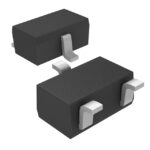 UMZ16NT106
The activity of extra discounts on wholesale prices is in full swing…
Please fill in your contact information and we will send you the latest wholesale price list.




