 ChipApex | Global Electronic Components Supplier
SEARCH
Search Product
Search Post
— IC芯片 | 连接器 | 传感器 | 被动器件 —
Search productSearch post
— IC芯片 | 连接器 | 传感器 | 被动器件 —
Consult the customer manager about the wholesale price.
consultation hotline:86-132-6715-2157
email:[email protected]
Contact the product manager for consultation. One-stop consultation is available.
Do you want a lower wholesale price? Please send us your inquiry and we will reply immediately.
The UMZ18NT106 is a Zener diode array manufactured by Rohm Semiconductor, designed for surface-mount applications. It features a dual configuration with a common anode setup housed in a UMD3 (SOT-323) package. The nominal Zener voltage is 18 V with a tolerance of ±2.19%, ensuring precise voltage regulation. The device supports a maximum power dissipation of 200 mW and operates within a junction temperature range up to 150°C. It meets AEC-Q101 automotive standards and includes reverse leakage current specifications of 100 nA at 13 V.
Verify the exact part number suffix against official Rohm documentation, as the provided model differs from the standard UMZ18NFHT106 designation found in public records. Confirm package type and electrical parameters match system requirements before procurement. Ensure compliance with RoHS directives and check for any specific automotive qualification certificates required for the intended application environment.
Select this component when a dual Zener array with common anode topology is required for compact designs. The 18 V rating and 200 mW power dissipation suit low-power signal conditioning tasks. Consider the SOT-323 footprint constraints and verify thermal management capabilities for operation near the 150°C junction temperature limit. Ensure compatibility with automated assembly processes given the reel packaging format.
This component belongs to the UMZ18 series of Zener arrays produced by Rohm Semiconductor. These devices are engineered specifically for terminal protection applications in automotive environments. The series offers various voltage options while maintaining consistent package dimensions and electrical characteristics to simplify supply chain management across different product lines.
Publicly documented substitutes include the UMZ18NFH and UMZ18NFHT106, which share identical pinouts and packages. Verify that replacement parts maintain the same AEC-Q101 qualification status and electrical tolerances to ensure seamless integration without redesigning the circuit board or updating firmware logic.
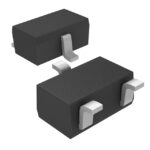 UMZ18NT106
The activity of extra discounts on wholesale prices is in full swing…
Please fill in your contact information and we will send you the latest wholesale price list.




