 ChipApex | Global Electronic Components Supplier
SEARCH
Search Product
Search Post
— IC芯片 | 连接器 | 传感器 | 被动器件 —
Search productSearch post
— IC芯片 | 连接器 | 传感器 | 被动器件 —
Consult the customer manager about the wholesale price.
consultation hotline:86-132-6715-2157
email:[email protected]
Contact the product manager for consultation. One-stop consultation is available.
Do you want a lower wholesale price? Please send us your inquiry and we will reply immediately.
The UMZ8.2NFHT106 is a dual common-anode Zener diode array manufactured by ROHM Semiconductor, designed for terminal protection applications in automotive environments. It operates within the SOT-323 (UMD3) surface-mount package, featuring a nominal Zener voltage of 8.2 V with a tight tolerance of ±2%. The device supports a maximum power dissipation of 200 mW and maintains a low reverse leakage current of 100 nA at 5.6 V. Certified to AEC-Q101 standards, it ensures high reliability with a junction temperature rating of up to 150°C and complies with RoHS directives.
Verify the specific ordering suffix HT106 to confirm tape-and-reel packaging containing 3000 units per reel. Ensure the procurement documentation explicitly references the AEC-Q101 qualification status required for automotive integration. Cross-reference the manufacturer part number against official ROHM databases to validate authenticity and traceability before finalizing acquisition orders.
Select this component when a dual-channel solution is required for bidirectional or unidirectional ESD protection on paired signal lines. The 8.2 V breakdown voltage suits 5 V logic systems, providing adequate clamping without interfering with normal operation. Verify that the 200 mW power rating aligns with the expected energy absorption requirements of the target application environment.
This device belongs to the UMZ series of low-capacitance Zener arrays specifically engineered for protecting I/O ports in automotive electronics. It shares the UMD3 package footprint with other variants in the family, such as the UMZ18NFHT106, allowing for standardized layout designs across different voltage protection levels within the same product line.
Direct pin-compatible substitutes within the same series include the UMZ5.6NFHT106 and UMZ18NFHT106. These alternatives offer identical package dimensions and electrical configurations but differ in their nominal Zener voltage ratings. Evaluate the specific clamping voltage requirements of the circuit before substituting to ensure proper protection thresholds are maintained.
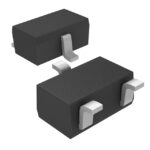 UMZ8.2NFHT106
The activity of extra discounts on wholesale prices is in full swing…
Please fill in your contact information and we will send you the latest wholesale price list.




