 ChipApex | Global Electronic Components Supplier
SEARCH
Search Product
Search Post
— IC芯片 | 连接器 | 传感器 | 被动器件 —
Search productSearch post
— IC芯片 | 连接器 | 传感器 | 被动器件 —
Consult the customer manager about the wholesale price.
consultation hotline:86-132-6715-2157
email:[email protected]
Contact the product manager for consultation. One-stop consultation is available.
Do you want a lower wholesale price? Please send us your inquiry and we will reply immediately.
The VO4258H-X006 is a non-zero crossing photo Triac optocoupler manufactured by Vishay Semiconductor Opto Division. It integrates a GaAs infrared LED optically coupled to a photosensitive TRIAC within a PDIP-6 package. Key electrical specifications include an isolation voltage of 5300 Vrms, a maximum repetitive peak off-state voltage (VDRM) of 800 V, and a maximum continuous output current of 300 mA. The device operates with a forward current of up to 60 mA, a forward voltage of 1.2 V, and a power dissipation of 600 mW. It features a maximum trigger current of 2 mA and functions reliably across a temperature range from -55°C to +100°C.
Verify the specific suffix X006 against the manufacturer's latest datasheet to confirm tube packaging and RoHS compliance status. Ensure the non-zero crossing characteristic aligns with the application requirements, as it differs from zero-crossing variants. Confirm that the 800 V blocking voltage meets the peak line voltage demands of the target circuit design before procurement.
Select this component when immediate turn-on is required rather than noise reduction associated with zero-crossing detection. The 800 V rating provides headroom for higher voltage AC lines compared to lower-rated siblings. Verify that the 300 mA continuous current capacity suffices for the connected load. The PDIP-6 form factor dictates the necessary footprint on the printed circuit board layout.
This part belongs to the VO425x series of Vishay phototriacs, distinguished by its non-zero crossing behavior. It shares the same physical DIP-6 package and basic electrical interface as other members like the VO4254H and VO4256H, differing primarily in the maximum off-state voltage rating. The series serves as a standard solution for isolating low-voltage control signals from medium-power AC loads.
Direct functional substitutes within the same family include the VO4254H (400 V rating) and VO4256H (600 V rating), provided the lower voltage ratings are acceptable for the application. Cross-family replacements require matching the 5300 Vrms isolation, 800 V blocking voltage, and non-zero crossing characteristics.
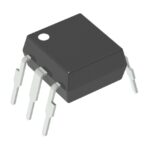 VO4258H-X006
The activity of extra discounts on wholesale prices is in full swing…
Please fill in your contact information and we will send you the latest wholesale price list.






