 ChipApex | Global Electronic Components Supplier
SEARCH
Search Product
Search Post
— IC芯片 | 连接器 | 传感器 | 被动器件 —
Search productSearch post
— IC芯片 | 连接器 | 传感器 | 被动器件 —
Consult the customer manager about the wholesale price.
consultation hotline:86-132-6715-2157
email:[email protected]
Contact the product manager for consultation. One-stop consultation is available.
Do you want a lower wholesale price? Please send us your inquiry and we will reply immediately.
The VOH260A-X001 is a single-channel high-speed optocoupler manufactured by Vishay Semiconductor Opto Division. It features an open-drain output and operates with a data rate of 10 MBd. The device provides 5000 Vrms isolation voltage and supports a common-mode transient immunity (CMTI) of 15 kV/µs. It utilizes a DIP-8 package for through-hole mounting. Key electrical parameters include a forward current of 10 mA, forward voltage of 1.38 V, rise time of 23 ns, and fall time of 10 ns. The output can handle up to 50 mA, with power dissipation rated at 125 mW. Operating temperatures range from -40°C to +110°C.
Verify the specific suffix X001 corresponds to the tube packaging format when ordering. Confirm that the 15 kV/µs CMTI specification aligns with your system's noise requirements. Ensure the DIP-8 through-hole footprint matches your PCB layout constraints. Check RoHS compliance status as indicated in the official datasheet before finalizing procurement specifications.
Select this component when high-speed digital isolation is required alongside robust transient immunity. The open-drain output necessitates an external pull-up resistor for proper logic level translation. Compare the 10 MBd speed against slower transistor-output optocouplers if bandwidth is critical. Ensure the 5000 Vrms isolation meets safety standards for your specific application voltage levels.
This part belongs to Vishay's high-speed optocoupler family, designed for demanding industrial applications. It complements other variants like the VOH260A which may differ in packaging or minor electrical characteristics. The series emphasizes reliability in noisy environments, distinguishing it from standard general-purpose optocouplers used in low-speed consumer electronics.
Direct substitutes within the same Vishay line include the VOH260A-X006, which shares similar electrical characteristics but differs in packaging format. Verify pinout compatibility and isolation voltage ratings when considering cross-manufacturer replacements to ensure functional equivalence.
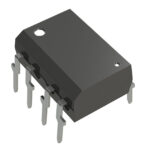 VOH260A-X001
The activity of extra discounts on wholesale prices is in full swing…
Please fill in your contact information and we will send you the latest wholesale price list.





