 ChipApex | Global Electronic Components Supplier
SEARCH
Search Product
Search Post
— IC芯片 | 连接器 | 传感器 | 被动器件 —
Search productSearch post
— IC芯片 | 连接器 | 传感器 | 被动器件 —
Consult the customer manager about the wholesale price.
consultation hotline:86-132-6715-2157
email:[email protected]
Contact the product manager for consultation. One-stop consultation is available.
Do you want a lower wholesale price? Please send us your inquiry and we will reply immediately.
The VOH263A-X016 is a high-speed dual-channel optocoupler manufactured by Vishay Semiconductor Opto Division. It features an open-drain logic output configuration with a data rate of 10 MBd and a common-mode transient immunity (CMTI) of 15 kV/µs. The device operates within an isolation voltage of 5000 Vrms and supports a forward current of 20 mA with a forward voltage of 1.38 V. Electrical characteristics include rise and fall times of 11 ns, a reverse voltage rating of 5 V, and an output current capacity of 50 mA. Power dissipation is rated at 85 mW, and the unit functions across a temperature range from -40°C to +110°C.
Verify the specific suffix X016 against official Vishay documentation to confirm packaging and tape-and-reel specifications. Ensure the required CMTI rating of 15 kV/µs aligns with system noise requirements. Confirm that the open-drain output topology matches the destination circuit's pull-up configuration. Validate thermal management capabilities given the 85 mW power dissipation limit in enclosed assemblies.
Select this component when dual-channel isolation is required alongside high-speed data transmission capabilities. The open-drain output necessitates external pull-up resistors, which must be sized to maintain signal integrity at 10 MBd. Consider the DIP-8 through-hole package constraints if PCB layout requires manual assembly or reworkability. Evaluate the 5000 Vrms isolation barrier against regulatory safety standards applicable to the target equipment design.
This device belongs to Vishay's high-speed optocoupler family, designed for robust signal transfer across isolated boundaries. The VOH263A series specifically targets applications demanding fast response times and high noise immunity. The X016 suffix typically denotes specific manufacturing or packaging variations within the broader VOH263A product line, distinguishing it from single-channel variants like the VOWH260A.
Direct substitutes may include other Vishay dual-channel high-speed optocouplers with similar pinouts and electrical ratings. Verify compatibility regarding CMTI specifications and output stage configurations before substitution. Single-channel alternatives require circuit redesign to accommodate separate components. Consult official cross-reference guides for validated replacements ensuring identical isolation voltages and speed characteristics.
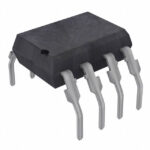 VOH263A-X016
The activity of extra discounts on wholesale prices is in full swing…
Please fill in your contact information and we will send you the latest wholesale price list.






