 ChipApex | Global Electronic Components Supplier

SEARCH
Search Product
Search Post
— IC芯片 | 连接器 | 传感器 | 被动器件 —
Search productSearch post
— IC芯片 | 连接器 | 传感器 | 被动器件 —
Consult the customer manager about the wholesale price.
consultation hotline:86-132-6715-2157
email:[email protected]
Contact the product manager for consultation. One-stop consultation is available.
Do you want a lower wholesale price? Please send us your inquiry and we will reply immediately.
VS-ST180S20P0PBF is listed in the Scrs range at ChipApex. The manufacturer field lists Vishay General Semiconductor - Diodes Division. Its product description is SCR 2KV 314A TO209AB. Review the specifications below when checking this part for your BOM.
The VS-ST180S20P0PBF is a phase control thyristor (SCR) in the Stud Version, rated for 200 A average on-state current and 1600 V to 2000 V repetitive peak off-state voltage. It features a hermetic metal case with a ceramic insulator and compression bonded encapsulation designed for heavy-duty operations like severe thermal cycling. The device utilizes a center amplifying gate and operates within a junction temperature range of -40 °C to +125 °C.
Verify component authenticity through authorized Vishay channels or certified distributors. Confirm datasheet revision 94397 and document date January 9, 2025. Ensure compliance with industrial level qualification standards and material categorization requirements specified in Vishay documentation before integration into designs.
Evaluate thermal resistance from junction to case at 0.105 K/W under DC operation conditions. Consider conduction angle impacts on maximum allowable case temperatures and RMS current ratings. Verify mounting torque specifications for non-lubricated threads at 31 N·m to ensure proper mechanical stability and electrical contact integrity during operation.
This component belongs to the ST180S series of phase control thyristors manufactured by Vishay Semiconductors. It is classified as an end-of-life product scheduled for discontinuation in December 2024. Engineers should consult Vishay directly for alternative solutions or updated product recommendations compatible with existing system architectures.
Contact Vishay for alternative solutions due to the End of Life status scheduled for December 2024. No specific public substitute part numbers are documented in the provided datasheet.
The maximum non-repetitive surge current is 5000 A at 50 Hz and 5230 A at 60 Hz for a single half-cycle sine wave pulse.
The maximum peak positive gate voltage is 20 V, while the maximum peak negative gate voltage is limited to 5.0 V.
Thermal resistance increases as the conduction angle decreases; for example, it rises from 0.015 K/W at 180° to 0.060 K/W at 30° conduction angles.
Explore related parts through Thyristors, Discrete Semiconductor Products, all product categories, ChipApex homepage.
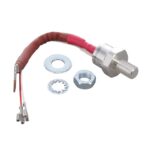 VS-ST180S20P0PBF

The activity of extra discounts on wholesale prices is in full swing…
Please fill in your contact information and we will send you the latest wholesale price list.





