 ChipApex | Global Electronic Components Supplier
SEARCH
Search Product
Search Post
— IC芯片 | 连接器 | 传感器 | 被动器件 —
Search productSearch post
— IC芯片 | 连接器 | 传感器 | 被动器件 —
Consult the customer manager about the wholesale price.
consultation hotline:86-132-6715-2157
email:[email protected]
Contact the product manager for consultation. One-stop consultation is available.
Do you want a lower wholesale price? Please send us your inquiry and we will reply immediately.
The VUO84-16NO7 is a three-phase rectifier bridge from the IXYS VUO84 series, designed for high-power industrial applications. It features a peak repetitive reverse voltage (Vrrm) of 1600 V and an average forward current (If) of 84 A at a case temperature of 110°C. The module utilizes planar passivated chips to ensure low leakage current and improved thermal cycling reliability. Key electrical parameters include a maximum forward voltage drop (Vf) of approximately 1.5 V and a peak non-repetitive surge current (Ifsm) of 900 A. The device operates within a junction temperature range of -40°C to +150°C and is housed in a PWS-E-5 screw-mount package.
Verify the specific manufacturer datasheet for the VUO84-16NO7 to confirm current availability status, as component lifecycles may change. Ensure that the ordering suffix matches the required pin configuration and packaging variant. Cross-reference technical specifications against the target application requirements before finalizing procurement decisions.
Select this component based on its 1600 V rating and 84 A continuous current capacity. Consider the thermal resistance characteristics and the requirement for screw mounting when designing the heatsink interface. Compare the forward voltage drop against alternative packages to optimize thermal management and conduction losses in the specific circuit topology.
This part belongs to the IXYS VUO series of three-phase rectifier bridges, which are engineered for robust performance in high-power electronics. The VUO84-16NO7 specifically targets applications requiring reliable AC-to-DC conversion under high thermal stress. It represents a standard solution for industrial power stages where compactness and durability are critical design constraints.
Potential substitutes include other IXYS models such as the VUO82-16NO7 or VUO98-16NO7, provided they meet the voltage and current requirements. Verify mechanical dimensions and terminal compatibility before substitution. Always consult official replacement guides to ensure functional equivalence.
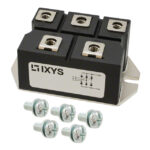 VUO84-16NO7
The activity of extra discounts on wholesale prices is in full swing…
Please fill in your contact information and we will send you the latest wholesale price list.





