 ChipApex | Global Electronic Components Supplier
SEARCH
Search Product
Search Post
— IC芯片 | 连接器 | 传感器 | 被动器件 —
Search productSearch post
— IC芯片 | 连接器 | 传感器 | 被动器件 —
Consult the customer manager about the wholesale price.
consultation hotline:86-132-6715-2157
email:[email protected]
Contact the product manager for consultation. One-stop consultation is available.
Do you want a lower wholesale price? Please send us your inquiry and we will reply immediately.
The W6810IS is a single-channel PCM CODEC designed for voiceband applications, operating from a single +5V power supply. It features pin-selectable μ-Law or A-Law companding compliant with ITU G.711 and filtering compliant with ITU G.712. The device supports seven master clock rates ranging from 256 kHz to 4.096 MHz via an internal pre-scaler. Electrical specifications include a typical power dissipation of 25 mW and a power-down mode consumption of 0.5 μW. It operates within an industrial temperature range of –40°C to +85°C and is available in 20-pin PDIP, SOG, SSOP, and TSSOP packages.
Verify the specific package suffix against the datasheet ordering information to ensure correct physical dimensions and pinout compatibility. Confirm that the component meets RoHS requirements if lead-free packaging is necessary for the assembly process. Check for any revision differences that might affect timing parameters or electrical characteristics relative to the current design requirements.
Select this component for systems requiring a single-channel voiceband codec with standard PCM interfaces. Ensure the system provides a stable +5V supply within the specified tolerance. Verify that the master clock frequency falls within the supported range of 256 kHz to 4.096 MHz. Consider the required companding format (μ-Law or A-Law) when designing the hardware configuration for the select pin.
The W6810 series includes variants such as W6810IW and W6810ISG TR, manufactured by Nuvoton Technology Corporation. These devices are part of a broader family of audio codecs designed for telecommunications and voice processing applications. The IS variant specifically denotes the SOP-20 package option among other available form factors like PDIP and TSSOP.
Direct replacements may include the W6810IW or W6810ISG TR from Nuvoton. Verify pin compatibility and electrical specifications before substitution. Other single-channel voiceband CODECs with similar interface protocols may serve as alternatives if pinouts differ.
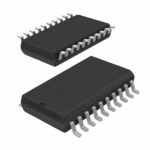 W6810IS
The activity of extra discounts on wholesale prices is in full swing…
Please fill in your contact information and we will send you the latest wholesale price list.





