 ChipApex | Global Electronic Components Supplier
SEARCH
Search Product
Search Post
— IC芯片 | 连接器 | 传感器 | 被动器件 —
Search productSearch post
— IC芯片 | 连接器 | 传感器 | 被动器件 —
Consult the customer manager about the wholesale price.
consultation hotline:86-132-6715-2157
email:[email protected]
Contact the product manager for consultation. One-stop consultation is available.
Do you want a lower wholesale price? Please send us your inquiry and we will reply immediately.
The W681310 is a single-channel PCM CODEC compliant with ITU G.712, operating from a single +3V supply (2.7V to 5.25V). It features pin-selectable μ-Law or A-Law companding per ITU G.711 and includes an on-chip precision voltage reference of 0.886 V for -5 dBm TLP at 600 Ω. The device accepts eight master clock rates between 256 kHz and 4.800 MHz via an internal pre-scaler. Typical power dissipation is 10 mW, reducing to 0.5 μW in power-down mode. It supports long/short frame sync, GCI, and IDL protocols, and drives 300 Ω loads differentially up to 3.544V peak-to-peak.
Verify the specific package suffix against the manufacturer's ordering information to ensure compatibility with the required footprint, such as SOG, SSOP, or TSSOP. Confirm that the component meets Pb-Free requirements if environmental compliance is necessary for the assembly process. Cross-reference the revision level B18 datasheet specifications with the delivered part lot to ensure functional consistency.
Select this component for applications requiring a single-channel voiceband codec with low power consumption. Ensure the system provides a stable 2.7V to 5.25V supply and supports the required master clock frequencies between 256 kHz and 4.800 MHz. Verify that the interface protocol matches the host processor's capabilities, whether using standard PCM frame sync or ISDN-specific GCI/IDL modes.
The W681310 belongs to Nuvoton's family of single-channel voiceband CODECs designed for industrial temperature ranges (-40°C to +85°C). It serves as a direct alternative to other models in the series, offering similar core functionalities but optimized for single-rail +3V operation. The device integrates essential filtering and amplification stages required for compliant PCM signal processing.
Check for W681512 variants when higher voltage supplies are available, noting the difference in operating voltage ranges. Verify pinout compatibility if substituting within the same package type, as interface configurations may vary slightly between revisions or specific sub-models.
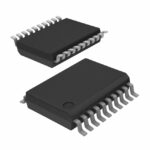 W681310R
The activity of extra discounts on wholesale prices is in full swing…
Please fill in your contact information and we will send you the latest wholesale price list.






