 ChipApex | Global Electronic Components Supplier
SEARCH
Search Product
Search Post
— IC芯片 | 连接器 | 传感器 | 被动器件 —
Search productSearch post
— IC芯片 | 连接器 | 传感器 | 被动器件 —
Consult the customer manager about the wholesale price.
consultation hotline:86-132-6715-2157
email:[email protected]
Contact the product manager for consultation. One-stop consultation is available.
Do you want a lower wholesale price? Please send us your inquiry and we will reply immediately.
The W681512S is a single-channel voiceband CODEC compliant with ITU-T G.712 specifications, manufactured by Nuvoton Technology Corporation. It operates on a single +5V power supply (4.5V to 5.5V) and features an 8-bit resolution at an 8 kHz sampling rate. The device includes pin-selectable μ-Law and A-Law companding per ITU-T G.711. It supports PCM interfaces with short frame sync, long frame sync, IDL, and GCI timing. The component integrates a fully differential analog output stage with push-pull power drivers capable of driving a 300Ω load up to 6.3V peak-to-peak. It functions within an industrial temperature range of -40°C to +85°C.
Verify the specific ordering suffix against the manufacturer's official documentation to confirm package type and temperature grade. Confirm current production status as some variants may be discontinued or subject to change. Ensure compatibility with system voltage requirements of 4.5V to 5.5V. Check for RoHS compliance status if environmental regulations apply to the deployment environment.
Select this component for applications requiring a single-channel PCM codec with integrated power amplification. It is suitable for designs needing pin-selectable companding standards without external logic. Consider the 20-pin SOP or SSOP packaging constraints during PCB layout. Verify that the host processor supports one of the four supported PCM timing environments for proper synchronization.
The W681512 series serves as a general-purpose single-channel PCM CODEC designed for voice signal digitization and reconstruction. It replaces legacy components such as the Motorola MC145480 and MC14LC5480. The device simplifies system design by integrating band-limiting filters and power drivers, reducing the need for external discrete components in voiceband processing circuits.
Cross-reference with Motorola MC145480 and MC14LC5480 for functional compatibility. Verify pinout and electrical characteristics match before substitution. Ensure the replacement supports the required ITU-T G.711 and G.712 standards.
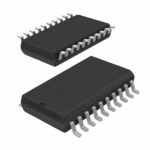 W681512S
The activity of extra discounts on wholesale prices is in full swing…
Please fill in your contact information and we will send you the latest wholesale price list.






