 ChipApex | Global Electronic Components Supplier
SEARCH
Search Product
Search Post
— IC芯片 | 连接器 | 传感器 | 被动器件 —
Search productSearch post
— IC芯片 | 连接器 | 传感器 | 被动器件 —
Consult the customer manager about the wholesale price.
consultation hotline:86-132-6715-2157
email:[email protected]
Contact the product manager for consultation. One-stop consultation is available.
Do you want a lower wholesale price? Please send us your inquiry and we will reply immediately.
The W682510 is a dual-channel voiceband PCM CODEC compliant with ITU G.712 and G.711 specifications. It operates from a single +5V power supply (4.5V to 5.5V) and features pin-selectable μ-Law or A-Law companding. The device includes an on-chip precision voltage reference and receive output buffer amplifiers capable of driving 600 Ω loads. It supports both parallel and serial synchronous PCM data interfaces via BCLK, FSR, and FST pins. An internal PLL eliminates the need for a master clock. Typical power dissipation is 35 mW, reducing to 5 μW in power-down mode. It functions within an industrial temperature range of –40°C to +85°C.
Verify component authenticity through authorized Nuvoton distributors or direct manufacturer channels. Confirm package type availability, as the W682510 is offered in 20-pin PDIP, SSOP, and 24-pin SOP options. Ensure that ordering suffixes match the required physical footprint and lead-free status. Request current lifecycle status documentation to confirm production availability before finalizing procurement plans.
Select the W682510 when a dedicated 5V dual-channel voiceband codec is required. Compare against the W682310 if a lower 3V operating voltage is necessary for the system design. Consider the specific package constraints, noting that the PDIP option is exclusive to the W682510 model. Verify that the application requires the specific 600 Ω load driving capability provided by this variant's output buffers.
This component belongs to the W682xx series of general-purpose dual-channel PCM CODECs manufactured by Nuvoton Technology Corporation. It is designed specifically for voiceband applications requiring compliance with international telecommunication standards. The series shares architectural similarities with the W682310, differing primarily in supply voltage requirements and specific analog output characteristics tailored for different line impedance environments.
The W682310 serves as a functional alternative for systems utilizing a 3V supply instead of 5V. Both devices share identical pinouts and interface protocols. Designers must verify that the target system voltage aligns with the replacement part's specifications before substitution.
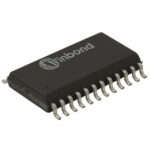 W682510S
The activity of extra discounts on wholesale prices is in full swing…
Please fill in your contact information and we will send you the latest wholesale price list.






