 ChipApex | Global Electronic Components Supplier
SEARCH
Search Product
Search Post
— IC芯片 | 连接器 | 传感器 | 被动器件 —
Search productSearch post
— IC芯片 | 连接器 | 传感器 | 被动器件 —
Consult the customer manager about the wholesale price.
consultation hotline:86-132-6715-2157
email:[email protected]
Contact the product manager for consultation. One-stop consultation is available.
Do you want a lower wholesale price? Please send us your inquiry and we will reply immediately.
The WM8533ECSN/R is a stereo digital-to-analog converter (DAC) featuring an integrated charge pump and DC servo, enabling 2Vrms ground-referenced line outputs from a single 3.3V supply. It supports sampling rates from 8kHz to 192kHz with I2C/SPI or hardware control interfaces. Key electrical specifications include a 106dB A-weighted SNR, -89dB THD at -1dBFS, and a maximum 1mV DC offset on line outputs. The device operates with AVDD/LINEVDD at 3.3V ±10% and DBVDD at 1.8V or 3.3V, housed in a 20-ball WCSP package.
Verify the ordering suffix /R indicates tape and reel packaging with a reel quantity of 5000 units. Confirm the temperature range is -40°C to +85°C and the package is a 20-ball W-CSP. Ensure the component is Pb-free and meets MSL1 moisture sensitivity requirements for storage conditions below 30°C and 85% relative humidity.
Select this component for applications requiring ground-referenced line outputs without external coupling capacitors. Ensure the system provides a stable 3.3V analog supply and a 1.8V or 3.3V digital I/O supply. Verify compatibility with the required audio data formats (LJ, RJ, I2S, DSP) and control interface (I2C or SPI). Check that the load impedance is at least 1kΩ for specified performance metrics.
The WM8533 is part of the Wolfson Microelectronics audio codec and DAC portfolio, designed for high-fidelity consumer electronics. It integrates a charge pump to boost voltage levels for line drivers, simplifying board design by removing large external capacitors. The device is suitable for multi-channel systems and offers flexible clocking options for various sample rates.
Publicly confirmed substitute part numbers are not available in the provided documentation. Consult manufacturer cross-reference guides for compatible devices with similar pinouts and electrical characteristics.
The CIFMODE pin selects the mode: Logic 0 for I2C, Logic 1 for SPI, and floating (Z state) for Hardware control.
The DC servo eliminates the need for line driving coupling capacitors and effectively removes power-on pops and clicks by minimizing DC transients at the output.
Yes, the digital audio interface supports both master and slave modes, selectable via the AIF_MSTR bit in Register 3.
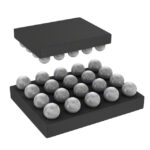 WM8533ECSN/R
The activity of extra discounts on wholesale prices is in full swing…
Please fill in your contact information and we will send you the latest wholesale price list.





