 ChipApex | Global Electronic Components Supplier
SEARCH
Search Product
Search Post
— IC芯片 | 连接器 | 传感器 | 被动器件 —
Search productSearch post
— IC芯片 | 连接器 | 传感器 | 被动器件 —
Consult the customer manager about the wholesale price.
consultation hotline:86-132-6715-2157
email:[email protected]
Contact the product manager for consultation. One-stop consultation is available.
Do you want a lower wholesale price? Please send us your inquiry and we will reply immediately.
The X66AK2E05XABD25 is a high-performance multicore digital signal processor and controller from Texas Instruments, belonging to the 66AK2E series. It integrates four ARM Cortex-A15 cores and four TMS320C66x DSP cores within a KeyStone II System-on-Chip architecture. The device operates with maximum clock frequencies of 1 GHz for both core types and utilizes an FCBGA-1089 package. Designed for demanding embedded applications, it supports fixed and floating-point instruction sets and includes extensive memory resources such as L1/L2 caches and DDR3L program memory support.
Verify component authenticity through authorized Texas Instruments distributors or certified suppliers. Confirm the specific suffix 'X' denotes the correct temperature grade and packaging variant required for your design. Check current lifecycle status as this part may be subject to obsolescence notices. Ensure supply chain documentation matches the exact manufacturer part number to avoid compatibility issues in production.
Select this model when four independent DSP cores are needed alongside ARM application processors. Compare against the 66AK2G series if fewer cores suffice, or the 66AK2H series for higher core counts. Verify that the FCBGA-1089 footprint fits your PCB layout constraints. Ensure power delivery circuits can handle the combined current requirements of multiple 1 GHz cores and I/O voltages ranging from 0.85 V to 3.3 V.
This component is part of the Texas Instruments 66AK2E family, which targets cost-sensitive yet performance-critical embedded markets. It shares architectural similarities with the 66AK2L and 66AK2H families but offers a specific balance of core count and package size. The 'X' prefix typically indicates a specific commercial or industrial temperature range variation within the standard 66AK2E05 configuration.
Direct pin-to-pin replacements within the same package are limited. Consider the 66AK2E02ABDA4 for lower core count needs or the 66AK2H06DAAW2 for higher performance, though these require schematic and layout modifications. Always validate software compatibility and peripheral configurations before switching between different members of the KeyStone II family.
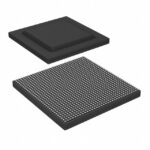 X66AK2E05XABD25
The activity of extra discounts on wholesale prices is in full swing…
Please fill in your contact information and we will send you the latest wholesale price list.






