 ChipApex | Global Electronic Components Supplier
SEARCH
Search Product
Search Post
— IC芯片 | 连接器 | 传感器 | 被动器件 —
Search productSearch post
— IC芯片 | 连接器 | 传感器 | 被动器件 —
Consult the customer manager about the wholesale price.
consultation hotline:86-132-6715-2157
email:[email protected]
Contact the product manager for consultation. One-stop consultation is available.
Do you want a lower wholesale price? Please send us your inquiry and we will reply immediately.
The X9C103SIT2 is a single-channel digitally controlled potentiometer (XDCP) manufactured by Renesas Electronics Corporation. It features a 10 kΩ end-to-end resistance with a linear taper and 100 discrete wiper tap points. The device utilizes a non-volatile memory architecture to store the wiper position, allowing for power-on recall of the last set value. Control is managed via a simple three-wire serial interface consisting of Chip Select (CS), Up/Down (U/D), and Increment (INC) pins. It operates on a single 5V supply voltage within a specified range of 4.5V to 5.5V.
Verify the specific suffix designation against official Renesas documentation, as variations such as 'T1' and 'T2' may indicate differences in packaging formats like tape-and-reel quantities or temperature grades. Confirm current lifecycle status, as some variants in the X9C103 series are marked as obsolete or subject to limited-time buys. Ensure compatibility with existing PCB footprints for the SOIC-8 package before procurement.
Select this component when a solid-state replacement for a 10kΩ mechanical potentiometer is required in space-constrained designs. The X9C103SIT2 is suitable for applications requiring infrequent resistance adjustments rather than high-speed variable attenuation. Verify that the microcontroller GPIO timing can meet the strict setup and hold times for the CS, U/D, and INC signals to ensure reliable writing operations.
The X9C103SIT2 belongs to the X9C10x family of digitally controlled potentiometers originally developed by Intersil and acquired by Renesas. This family is characterized by its low pin count and ease of integration into embedded systems. The 'S' denotes the SOIC-8 surface-mount package, while the suffix indicates specific manufacturing or packaging revisions within the product line.
Direct pin-compatible replacements include other variants within the X9C103 series, such as the X9C103SZ or X9C103SIZT1, provided the packaging and electrical tolerances match the design requirements. For higher resolution needs, consider the X9110 series, though it requires an SPI interface and different control logic.
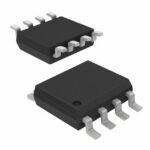 X9C103SIT2
The activity of extra discounts on wholesale prices is in full swing…
Please fill in your contact information and we will send you the latest wholesale price list.




