 ChipApex | Global Electronic Components Supplier
SEARCH
Search Product
Search Post
— IC芯片 | 连接器 | 传感器 | 被动器件 —
Search productSearch post
— IC芯片 | 连接器 | 传感器 | 被动器件 —
Consult the customer manager about the wholesale price.
consultation hotline:86-132-6715-2157
email:[email protected]
Contact the product manager for consultation. One-stop consultation is available.
Do you want a lower wholesale price? Please send us your inquiry and we will reply immediately.
The X9C503P is a solid-state nonvolatile digital potentiometer manufactured by Renesas Electronics Corporation (formerly Intersil). It features a 50 kΩ end-to-end resistance with a linear taper and 100 wiper tap points. The device utilizes a three-wire serial interface (CS, U/D, INC) to control the wiper position via internal CMOS switches. Key specifications include a 5V supply voltage range of 4.5V to 5.5V, an active current of 3mA maximum, and standby current of 750µA maximum. The wiper position is stored in nonvolatile memory for recall upon power-up, ensuring data retention for up to 100 years with 100,000 endurance cycles per bit.
Verify the package type when ordering, as the X9C503 series is available in both 8-lead SOIC and 8-lead PDIP formats. Confirm RoHS compliance status if lead-free components are required for the assembly process. Check manufacturer documentation for any specific handling instructions related to the nonvolatile memory endurance limits during programming operations.
Select the X9C503P specifically for applications requiring a 50 kΩ resistance value; other variants like X9C103 or X9C104 offer different resistance levels. Ensure the design supports a single 5V supply, as the device operates within a 4.5V to 5.5V range. Consider the 100-tap resolution, where each step represents approximately 505Ω, against the required precision of the application.
The X9C503P belongs to the XDCP™ (Digitally Controlled Potentiometer) family from Intersil/Renesas. It shares architectural similarities with the X9C102, X9C103, and X9C104 models, differing primarily in total resistance. This component serves as a solid-state replacement for mechanical potentiometers in environments where physical wear or vibration could compromise performance.
Direct pin-compatible replacements exist within the same X9C series family, such as the X9C103 or X9C104, provided the resistance value difference is acceptable for the circuit design. Verify that alternative sources maintain the same 3-wire interface protocol and nonvolatile memory behavior.
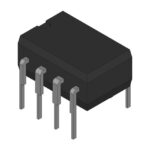 X9C503P
The activity of extra discounts on wholesale prices is in full swing…
Please fill in your contact information and we will send you the latest wholesale price list.




