 ChipApex | Global Electronic Components Supplier
SEARCH
Search Product
Search Post
— IC芯片 | 连接器 | 传感器 | 被动器件 —
Search productSearch post
— IC芯片 | 连接器 | 传感器 | 被动器件 —
Consult the customer manager about the wholesale price.
consultation hotline:86-132-6715-2157
email:[email protected]
Contact the product manager for consultation. One-stop consultation is available.
Do you want a lower wholesale price? Please send us your inquiry and we will reply immediately.
The X9C503SI is a single-channel digital potentiometer manufactured by Renesas Electronics Corporation, part of the XDCP series. It features a 50 kΩ end-to-end resistance with a linear taper and 100 tap points (99 resistive elements). The device utilizes a nonvolatile memory architecture to store wiper positions, enabling power-on recall. It operates on a single 5V supply (4.5V to 5.5V range) and communicates via a three-wire interface consisting of CS, U/D, and INC pins. The component is housed in an 8-SOIC package and supports industrial temperature ranges.
Verify the specific suffix 'SI' against the manufacturer's current datasheet to confirm the extended industrial temperature range (-40°C to +85°C) compared to commercial variants. Ensure the ordering information matches the required tape-and-reel or tube packaging format, as availability varies by distributor channel. Cross-reference the RoHS compliance status with the latest environmental declarations.
Select this component when nonvolatile storage of the resistance setting is required without external memory. The 50kΩ value suits moderate impedance applications; verify input impedance requirements against the 40Ω typical wiper resistance. Confirm that the 3-wire serial interface aligns with the host controller's GPIO capabilities. Consider the ±20% tolerance if high precision is critical.
The X9C503SI belongs to the X9C102/103/104/503 family of digitally controlled potentiometers originally developed by Intersil and now produced by Renesas. This family shares a common control logic and pinout, differing primarily in total resistance values. The 'SI' designation typically indicates the industrial temperature grade variant within the SOIC-8 package lineup.
Direct pin-compatible replacements include other members of the X9C10x family, such as the X9C104 (100kΩ) or X9C103 (10kΩ), provided the resistance value meets circuit requirements. Verify that substitute components support the same 3-wire interface and nonvolatile memory behavior.
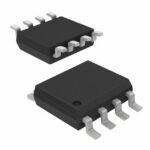 X9C503SI
The activity of extra discounts on wholesale prices is in full swing…
Please fill in your contact information and we will send you the latest wholesale price list.




