ChipApex | Global Electronic Components Supplier
SEARCH
Search Product
Search Post
— IC芯片 | 连接器 | 传感器 | 被动器件 —
Search productSearch post
— IC芯片 | 连接器 | 传感器 | 被动器件 —
Consult the customer manager about the wholesale price.
consultation hotline:86-132-6715-2157
email:[email protected]
Contact the product manager for consultation. One-stop consultation is available.
Do you want a lower wholesale price? Please send us your inquiry and we will reply immediately.
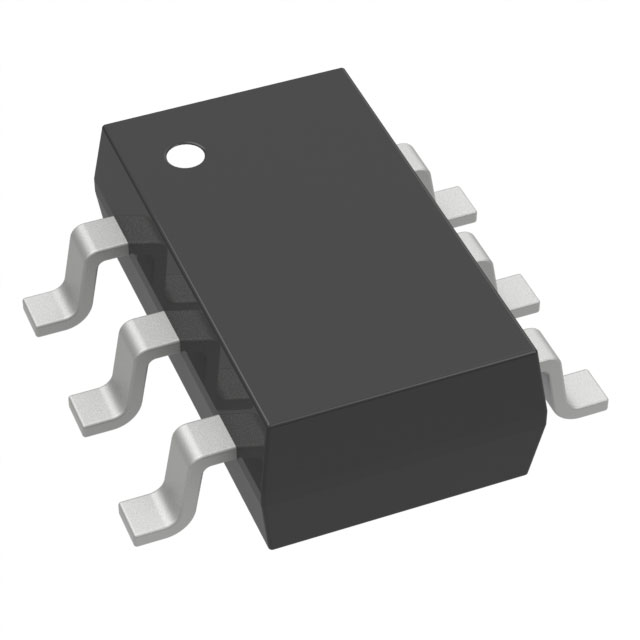
The Panasonic XN06211 is a composite transistor array containing two NPN silicon epitaxial planar transistors with built-in base resistors in a single SC-74 Mini6-G1 package. It operates with a collector-emitter voltage of 50V and a maximum collector current of 100mA per element. The total power dissipation is rated at 300mW, with a transition frequency of 150MHz. Internal connections utilize pin 1 and 3 as collectors, pins 2 and 4 as bases, and pins 5 and 6 as emitters for the respective elements.
Verify component lifecycle status directly with Panasonic Industry before procurement planning. The datasheet indicates maintenance or discontinued classifications that may affect long-term supply availability. Confirm specific ordering suffixes and packaging formats with authorized distributors to ensure compatibility with existing inventory management systems.
Select this component when dual NPN switching functionality with integrated base resistance is required in a minimal footprint. Ensure the design accommodates the 300mW total power dissipation limit across both elements. Verify that the 50V collector-emitter voltage rating meets the circuit's maximum operating conditions under all transient states.
This device belongs to the XN6211 series of composite transistors manufactured by Panasonic Industry. It serves as a direct replacement for configurations previously requiring two separate discrete transistors and external biasing resistors. The component is designed for standard electronic equipment applications where space efficiency and simplified circuit topology are prioritized.
The UNR2211 (UN2211) is listed as the conventional part number equivalent. Verify pinout compatibility and electrical parameter tolerances against the original discrete design requirements before substitution.
The marking symbol on the package is 7Z.
Pin 1 is Collector (Tr1), Pin 2 is Base (Tr1), Pin 3 is Collector (Tr2), Pin 4 is Base (Tr2), Pin 5 is Emitter (Tr2), and Pin 6 is Emitter (Tr1).
The typical input resistance (R1) is 10 kΩ, with a tolerance range of -30% to +30%.
 XN0621100L
The activity of extra discounts on wholesale prices is in full swing…
Please fill in your contact information and we will send you the latest wholesale price list.