ChipApex | Global Electronic Components Supplier
SEARCH
Search Product
Search Post
— IC芯片 | 连接器 | 传感器 | 被动器件 —
Search productSearch post
— IC芯片 | 连接器 | 传感器 | 被动器件 —
Consult the customer manager about the wholesale price.
consultation hotline:86-132-6715-2157
email:[email protected]
Contact the product manager for consultation. One-stop consultation is available.
Do you want a lower wholesale price? Please send us your inquiry and we will reply immediately.
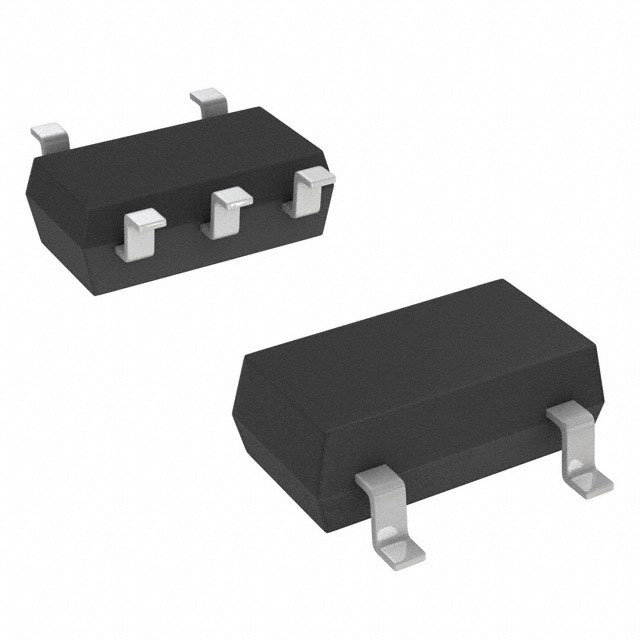
The XP0111100L is a composite transistor featuring two silicon PNP epitaxial planar elements integrated into a single SMini5-G1 package. Designed for digital circuits, it incorporates emitter-coupled transistors with built-in base resistors to reduce mounting area and assembly costs. Key electrical parameters include a collector-emitter voltage of -50V, a maximum collector current of -100mA, and a total power dissipation of 150mW at 25°C. The device exhibits a transition frequency of 80MHz and a forward current transfer ratio (hFE) minimum of 35 at -5mA. It complies with the RoHS Directive.
Verify component authenticity through authorized Panasonic distributors or official channels. Confirm the specific ordering suffix matches the required packaging format. Check the manufacturer's lifecycle status page for current availability and end-of-life notifications before finalizing procurement plans.
Select this component when space constraints require dual transistor functionality within a minimal footprint. Ensure the design accommodates the -50V voltage limits and 150mW thermal dissipation requirements. Verify that the internal resistor values align with the target logic interface specifications.
This part belongs to the XP01111 series of composite transistors manufactured by Panasonic Industry. It serves as a discrete semiconductor solution for replacing multiple individual components in digital switching applications, offering a standardized alternative to custom discrete arrangements.
Consult the official Panasonic cross-reference documentation for verified substitute part numbers. Do not assume functional equivalence with other SMini5 packages without verifying pinout and electrical parameter alignment.
The device contains two independent PNP transistors. Pin 1 is Base (Tr1), Pin 2 is Emitter (shared), Pin 3 is Base (Tr2), Pin 4 is Collector (Tr2), and Pin 5 is Collector (Tr1).
The maximum collector-base voltage (V_CBO) with the emitter open is -50V.
Yes, the product complies with the RoHS Directive (EU 2002/95/EC).
 XP0111100L
The activity of extra discounts on wholesale prices is in full swing…
Please fill in your contact information and we will send you the latest wholesale price list.