 ChipApex | Global Electronic Components Supplier
SEARCH
Search Product
Search Post
— IC芯片 | 连接器 | 传感器 | 被动器件 —
Search productSearch post
— IC芯片 | 连接器 | 传感器 | 被动器件 —
Consult the customer manager about the wholesale price.
consultation hotline:86-132-6715-2157
email:[email protected]
Contact the product manager for consultation. One-stop consultation is available.
Do you want a lower wholesale price? Please send us your inquiry and we will reply immediately.
The Z0109MAG is a silicon bidirectional thyristor (Triac) from the Sensitive Gate Triacs Series, manufactured by onsemi. It features a TO-92 package and is designed for solid state relays, MPU interfaces, and TTL logic applications. Key electrical parameters include a peak repetitive off-state voltage of 600 V, an on-state RMS current of 1.0 A, and a peak non-repetitive surge current of 8.0 A. The device supports sensitive gate triggering in all four quadrants with a maximum gate trigger current of 10 mA. It operates within a junction temperature range of -40°C to +125°C and offers improved noise immunity with a minimum commutating dv/dt of 10 V/µs at 110°C.
Verify the specific ordering suffix 'G' corresponds to bulk packaging in boxes of 5000 units per the manufacturer's shipping information. Confirm that the component is lead-free and RoHS compliant as indicated in the datasheet. Ensure the procurement channel provides valid traceability documentation for semiconductor components intended for industrial or consumer electronics assembly lines.
Select this component when a low-cost, through-hole TRIAC is required for direct microcontroller or TTL logic driving without additional buffer stages. The 600V blocking voltage and 1A RMS current rating make it suitable for low-power AC loads. Consider the thermal resistance characteristics and derating curves if operating near maximum current limits or elevated ambient temperatures.
The Z0109MA series belongs to onsemi's portfolio of sensitive gate triacs designed for cost-effective AC power control. These devices are engineered to simplify circuit design by allowing direct drive from standard logic families. The TO-92 package variant offers a compact solution for applications where surface-mount technology is not mandated, providing robust performance in general-purpose switching environments.
Check for equivalent parts from other manufacturers offering similar 600V, 1A sensitive gate TRIACs in TO-92 packages. Verify pinout compatibility (MT1, Gate, MT2) and ensure that gate trigger current specifications match the driving circuit capabilities. Confirm that thermal and mechanical dimensions align with existing board layouts if physical replacement is necessary.
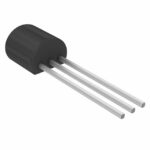 Z0109MAG
The activity of extra discounts on wholesale prices is in full swing…
Please fill in your contact information and we will send you the latest wholesale price list.





