ChipApex | Global Electronic Components Supplier
SEARCH
Search Product
Search Post
— IC芯片 | 连接器 | 传感器 | 被动器件 —
Search productSearch post
— IC芯片 | 连接器 | 传感器 | 被动器件 —
Consult the customer manager about the wholesale price.
consultation hotline:86-132-6715-2157
email:[email protected]
Contact the product manager for consultation. One-stop consultation is available.
Do you want a lower wholesale price? Please send us your inquiry and we will reply immediately.
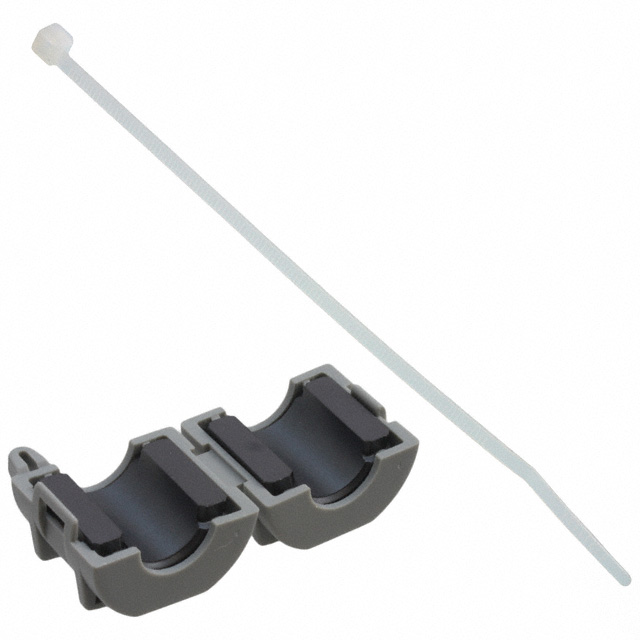
The TDK ZCAT2017-0930 is a two-piece clamp-on ferrite core designed for common-mode noise suppression on round cables with a maximum diameter of 9mm. It features a snap-on chassis mount design with an inner diameter of 9mm and outer diameter of 20mm. The component measures 21mm in length and 17mm in width, operating within a temperature range of -40°C to +85°C. Its impedance is specified as 50Ω at frequencies between 100MHz and 500MHz.
Verify the exact part number suffix when ordering, as variations such as ZCAT2017-0930B or ZCAT2017-0930-BK may exist with different color codes or packaging quantities but identical electrical characteristics. Confirm that the cable diameter does not exceed the 9mm maximum inner diameter specification to ensure proper fit and effective noise attenuation performance.
Select this component when retrofitting EMI filters onto existing cable assemblies where through-hole mounting is impractical. Ensure the target application involves round cables up to 9mm in diameter. Verify that the required noise suppression frequency range aligns with the 100MHz to 500MHz impedance profile. Consider environmental temperature constraints against the -40°C to +85°C operating limit.
This component belongs to TDK's ZCAT series of clamp-on ferrite cores. These parts are engineered for easy integration into electronic systems requiring post-assembly EMI mitigation. The series offers various sizes and impedance profiles to accommodate different cable diameters and frequency requirements across diverse industrial and consumer applications.
Publicly confirmed substitute part numbers are not available in the provided documentation. Users should consult official TDK catalogs for direct equivalents based on specific impedance and dimensional requirements.
The ZCAT2017-0930 supports round cables with a maximum diameter of 9mm.
No, this model is specifically designed for round cables. Flat cable variants typically have different part number suffixes, such as ZCAT2017-0930-BK.
The component operates reliably within a temperature range of -40°C to +85°C.
 ZCAT2017-0930
The activity of extra discounts on wholesale prices is in full swing…
Please fill in your contact information and we will send you the latest wholesale price list.