 ChipApex | Global Electronic Components Supplier
SEARCH
Search Product
Search Post
— IC芯片 | 连接器 | 传感器 | 被动器件 —
Search productSearch post
— IC芯片 | 连接器 | 传感器 | 被动器件 —
Consult the customer manager about the wholesale price.
consultation hotline:86-132-6715-2157
email:[email protected]
Contact the product manager for consultation. One-stop consultation is available.
Do you want a lower wholesale price? Please send us your inquiry and we will reply immediately.
The ZL40268 is a low-skew, low-additive jitter fanout buffer featuring eight differential outputs and a 3-to-1 input multiplexer. It supports clock frequencies from 0 to 1.5 GHz with ultra-low additive jitter of 24 fs (12 kHz to 20 MHz at 625 MHz). The device accepts differential or single-ended inputs including LVPECL, HCSL, LVDS, SSTL, CML, and LVCMOS, plus a crystal input. Outputs are configurable as HCSL, LVDS, or LVPECL, powered by 2.5V or 3.3V supplies. Maximum output-to-output skew is 50 ps. Control is via I2C bus or hardware pins, with factory-configurable OTP settings.
Verify the specific ordering suffix for packaging configuration, such as reel or tray options, against the manufacturer's current product identification system. Confirm that the selected variant matches the required power supply voltage (2.5V or 3.3V) and output drive type specifications for the target application design.
Select the ZL40268 when low additive jitter and high output count are required for PCIe or high-speed serial links. Ensure the input source matches the supported formats (LVPECL, HCSL, LVDS, etc.) and verify that the 50 ps maximum skew meets the system timing requirements. Check if I2C programmability or hardware pin control better suits the board layout constraints.
The ZL40268 belongs to Microchip's SmartBuffer family of clock distribution devices. It is designed for high-performance applications requiring precise clock synchronization. The device integrates an embedded LDO for improved power supply noise rejection, distinguishing it from standard fanout buffers that may require external filtering components.
Direct replacements within the same package and pinout should be verified against the official cross-reference list. Devices like the ZL40264 or ZL40269 may offer similar functionality but with different output counts or jitter specifications. Always confirm electrical compatibility and register map differences before substitution.
The ZL40268 supports clock frequencies from 0 Hz up to 1.5 GHz.
Yes, the device supports 2.5V ±5% or 3.3V ±5% power supplies for both VDD and VDDO pins.
Output types (HCSL, LVDS, LVPECL, or High-Z) can be programmed via the I2C bus registers or controlled using hardware pins OUT_TYPE_SEL0 and OUT_TYPE_SEL1.
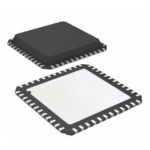 ZL40268LDF1
The activity of extra discounts on wholesale prices is in full swing…
Please fill in your contact information and we will send you the latest wholesale price list.




