 ChipApex | Global Electronic Components Supplier
SEARCH
Search Product
Search Post
— IC芯片 | 连接器 | 传感器 | 被动器件 —
Search productSearch post
— IC芯片 | 连接器 | 传感器 | 被动器件 —
Consult the customer manager about the wholesale price.
consultation hotline:86-132-6715-2157
email:[email protected]
Contact the product manager for consultation. One-stop consultation is available.
Do you want a lower wholesale price? Please send us your inquiry and we will reply immediately.
The ZTL431AQFTA is a three-terminal adjustable precision shunt regulator from Diodes Incorporated, designed for automotive applications. It operates within an ambient temperature range of -40°C to +125°C and features Grade A initial tolerance of 1%. The device allows output voltage adjustment between 2.5V and 20V using external resistors. It supports a cathode current range of 1mA to 100mA with a typical dynamic output impedance of 0.2Ω. The part is housed in an SOT-23 package.
Verify the specific ordering suffix 'F' corresponds to the SOT-23 package configuration required for your design. Confirm that Grade A (1% tolerance) meets your circuit accuracy requirements. Ensure the component is sourced through authorized channels to guarantee authenticity and compliance with IATF 16949 manufacturing standards.
Select this component when automotive qualification and high temperature stability are required. Compare against standard TL431 variants if higher maximum operating voltages are needed, as this series is limited to 20V. Consider the SOT-25 package option if a different pinout or thermal profile is preferred over the SOT-23 form factor.
This device belongs to the ZTL431AQ family of adjustable precision shunt regulators. It is functionally equivalent to the TL431/TL432 series but offers an extended ambient temperature range and automotive-specific change control. The 'Q' suffix indicates AEC-Q100 qualification, while 'A' denotes the 1% reference voltage tolerance grade.
ZTL431BQFTA serves as a direct substitute offering 0.5% tolerance instead of 1%. For non-automotive designs requiring higher voltage ratings, the standard TL431AFDT may be considered, though it lacks the specific automotive qualification and extended temperature range of the ZTL431AQFTA.
The maximum continuous cathode voltage (VKA) is rated at 20V.
The output voltage is set to any chosen value between 2.5V and 20V by selecting two external divider resistors.
Yes, the device is stable with a range of capacitive loads, though a capacitor of 4.7nF or greater is recommended between anode and cathode to ensure reliable stability.
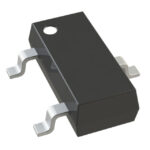 ZTL431AQFTA
The activity of extra discounts on wholesale prices is in full swing…
Please fill in your contact information and we will send you the latest wholesale price list.





