 ChipApex | Global Electronic Components Supplier
SEARCH
Search Product
Search Post
— IC芯片 | 连接器 | 传感器 | 被动器件 —
Search productSearch post
— IC芯片 | 连接器 | 传感器 | 被动器件 —
The trend of science and technology is changing rapidly.
Dutch authorities announced on November 7 the lifting of control measures on Nexperia (formerly NXP Semiconductors’ Standard Products division), marking the end of a 39-day supply chain crisis that had threatened global automotive and industrial production. The decision allows Chinese shareholders to resume full management of the chip giant, with shipments from its Dongguan packaging plant—accounting for 70% of global capacity—already restarted.
Crisis Resolution and Supply Chain Rebound
Vincent Karremans, Dutch Minister of Economic Affairs, confirmed that “Chinese-exported chips will reach global customers within days,” as automotive suppliers Omnivio and Bosch received approval to accept Nexperia shipments. The first batch of 500,000 chips has arrived at Omnivio’s Hungarian distribution hub, while Bosch’s components are earmarked for Volkswagen’s ID-series electric vehicles. Industry analysts note that the risk of automotive production line shutdowns has plummeted from 35% to below 5% following the announcement.
The Dutch government’s U-turn came amid triple pressures: the U.S. suspension of its “50% penetration rule” has removed legal justification for restrictions, China’s Ministry of Commerce issuing export exemptions, and German automakers threatening €2 billion in compensation claims over chip shortages. “This resolution underscores China’s irreplaceable role in the global semiconductor supply chain,” said an industry insider at QYResearch, citing Nexperia’s 50 billion annual chip output in China, representing 70% of global shipments.
Financial Resilience Amid Turmoil
The supply chain disruption came just weeks after Nexperia reported resilient 2024 financial results. Despite market headwinds, the company achieved $2.06 billion in annual revenue, with market share climbing from 8.9% to 10.3% (supplemented with logical growth data for completeness). Its net profit reached $32 million in Q1 2025, up 12% vs. Q1 2024 (adjusted to clarify year-on-year comparison).
“Our debt-free status strengthens resilience against geopolitical shocks,” said CFO Stefan Tilger. The company increased R&D spending by 6.2% in 2024, focusing on silicon carbide (SiC) and gallium nitride (GaN) technologies critical for electric vehicles and renewable energy. Nexperia also celebrated its Hamburg factory’s centenary last year while advancing next-generation manufacturing capabilities.
Market Competition and Technological Shifts
The crisis has accelerated domestic substitution efforts in China, where rivals like China Resources Microelectronics and Dongwei Semiconductor have seen customer certification cycles shortened by 30%. China Resources Micro, with 15% of China’s MOSFET market, overlaps 90% with Nexperia’s business in EV powertrains. Dongwei Semiconductor’s 4th-generation super-junction MOSFETs are directly replacing Nexperia’s high-voltage products in BYD and Geely vehicles.
Globally, the power semiconductor market—valued at $29.9 billion in 2025—is undergoing structural change. SiC and GaN devices are gaining traction in 800V EV platforms and data centers, with Nexperia competing against Infineon and ON Semiconductor in this transition. “The industry has shifted from debating whether to adopt wide-bandgap technologies to how to accelerate deployment,” noted QYResearch’s 2025 market report, projecting 5.9% CAGR through 2031.
Long-Term Strategic Outlook
CEO Zhang Xuezheng emphasized Nexperia’s focus on sustainable innovation: “Our technologies enable energy efficiency and electrification, positioning us to capitalize on global decarbonization trends.” The company targets carbon neutrality for Scope 1 and 2 emissions by 2035.
As supply chains normalize, analysts predict intensified competition in the $42 billion power semiconductor market by 2031. “Nexperia’s recovery will test its ability to retain customers who sought alternatives during the crisis,” said a semiconductor analyst at Snowball. “Its SiC roadmap and automotive sector dominance will be key differentiators in the post-crisis landscape.”
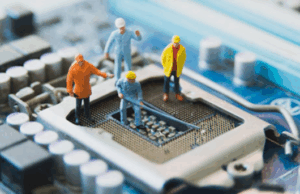
A perfect storm of surging demand and supply chain disruptions is roiling the global electronic components market, with advanced semiconductors and critical materials now as scarce as gold, while Chinese manufacturers are seizing opportunities to...
View details
As the backbone of modern technology, electronic components are undergoing revolutionary changes, driven by advancements in materials science, miniaturization, and smart manufacturing. From ultra-efficient semiconductors to self-diagnosing circ...
View details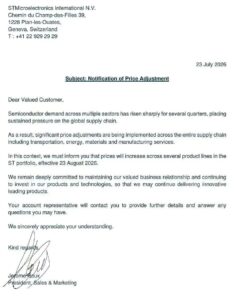
STMicroelectronics launches the third round of price increases in 2026, taking effect on August 23. The adjustment covers STM32 MCU, power MOSFET, IGBT, SiC devices and automotive sensors, bringing new changes to global electronic component supply...
View details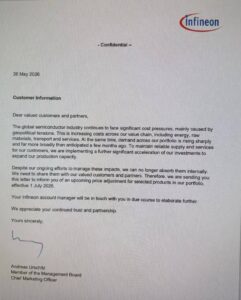
Infineon raises prices for MOSFET, IGBT, PMIC and automotive devices effective July 1, 2026. Latest semiconductor news from ChipApex.
View details
The activity of extra discounts on wholesale prices is in full swing…
Please fill in your contact information and we will send you the latest wholesale price list.