 ChipApex | Global Electronic Components Supplier
SEARCH
Search Product
Search Post
— IC芯片 | 连接器 | 传感器 | 被动器件 —
Search productSearch post
— IC芯片 | 连接器 | 传感器 | 被动器件 —
Consult the customer manager about the wholesale price.
consultation hotline:86-132-6715-2157
email:[email protected]
Contact the product manager for consultation. One-stop consultation is available.
Do you want a lower wholesale price? Please send us your inquiry and we will reply immediately.
The Altera 10AS057H2F34E2LG is an Arria 10 SX 570 SoC FPGA featuring 570,000 logic elements and 217,080 adaptive logic modules. It integrates a dual-core ARM Cortex-A9 processor running at 1.2 GHz with 64 KB L1 instruction and data caches per core. The device includes 35.16 Mbit of embedded memory and supports up to 696 I/Os. It utilizes HBM2 memory interfaces and incorporates 36 transceivers capable of 17.4 Gb/s data rates. Operating within a temperature range of 0°C to +100°C, it is housed in an FBGA-1152 package.
Verify the specific ordering suffix E2LG against the official Intel/Altera datasheet to confirm package type, pin count, and moisture sensitivity level. Ensure compliance with export control classifications such as ECCN 3A991 if applicable to your region. Confirm that the component meets RoHS directives and check for any product change notifications affecting manufacturing or material composition prior to final procurement decisions.
Select this model when design requirements exceed the capacity of smaller Arria 10 variants but do not necessitate the Stratix 10 family. Evaluate power consumption profiles under maximum load conditions, as the integration of HBM2 and high-speed transceivers impacts thermal management. Compare pin compatibility with existing board layouts, noting the FBGA-1152 footprint constraints and I/O voltage requirements for interface matching.
This component belongs to the Arria 10 SX series, which targets cost-sensitive applications requiring significant logic density and embedded processing capabilities. It sits between the lower-density Arria 10 GX models and the higher-end Stratix 10 FPGAs. The SX series is optimized for mid-to-high volume production where performance-per-watt and total cost of ownership are critical design drivers.
Direct pin-compatible replacements within the same family include other Arria 10 SX 570 variants with different speed grades or package options, such as 10AS057K2F34E2LG. Cross-family migration to Stratix 10 requires significant redesign due to architectural differences. Always verify software toolchain compatibility and IP core availability before substituting.
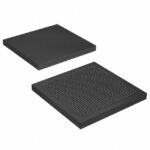 10AS057H2F34E2LG
The activity of extra discounts on wholesale prices is in full swing…
Please fill in your contact information and we will send you the latest wholesale price list.




