 ChipApex | Global Electronic Components Supplier
SEARCH
Search Product
Search Post
— IC芯片 | 连接器 | 传感器 | 被动器件 —
Search productSearch post
— IC芯片 | 连接器 | 传感器 | 被动器件 —
Consult the customer manager about the wholesale price.
consultation hotline:86-132-6715-2157
email:[email protected]
Contact the product manager for consultation. One-stop consultation is available.
Do you want a lower wholesale price? Please send us your inquiry and we will reply immediately.
The Vishay 18TQ045S is a Schottky rectifier in the TO-263AB (D2PAK) package. It features an average forward current of 18 A and a maximum repetitive peak reverse voltage of 45 V. The device supports junction temperatures up to 175 °C, with a typical forward voltage drop of 0.53 V at 18 A and 125 °C. Maximum non-repetitive surge current reaches 1800 A for 5 µs pulses. Thermal resistance from junction to case is 1.50 °C/W under DC operation.
Verify the specific suffix against the datasheet ordering table to confirm packaging orientation and lead-free status. Confirm that the D2PAK variant matches the required thermal management design. Ensure the 45 V rating aligns with the circuit's peak reverse voltage requirements. Check for any recent revisions to the document number 93950 regarding electrical characteristics.
Select this component when high-frequency operation and low forward voltage drop are critical for efficiency. The 175 °C junction temperature capability allows for robust performance in thermally constrained environments. Consider the 1.50 °C/W thermal resistance for heatsink calculations. The D2PAK package offers a balance of current handling and surface mount convenience.
This part belongs to the Vishay 18TQ...S Schottky rectifier series, which includes variants with different voltage ratings such as 35 V and 40 V. All members share the same 18 A current rating and D2PAK package style. The series is designed for general-purpose high-power applications requiring reliable switching performance.
Direct substitutes within the same series include the 18TQ035S and 18TQ040S if lower voltage ratings are acceptable. Verify pinout compatibility and thermal resistance specifications when considering alternative manufacturers' Schottky rectifiers in the D2PAK package.
The maximum junction temperature range is -55 °C to 175 °C.
At 18 A, the forward voltage drop is 0.60 V at 25 °C and decreases to 0.53 V at 125 °C.
The typical junction capacitance is 1400 pF measured at VR = 5 VDC with a test signal frequency between 100 kHz and 1 MHz.
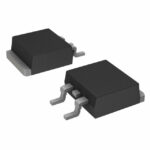 18TQ045S
The activity of extra discounts on wholesale prices is in full swing…
Please fill in your contact information and we will send you the latest wholesale price list.






