 ChipApex | Global Electronic Components Supplier
SEARCH
Search Product
Search Post
— IC芯片 | 连接器 | 传感器 | 被动器件 —
Search productSearch post
— IC芯片 | 连接器 | 传感器 | 被动器件 —
Consult the customer manager about the wholesale price.
consultation hotline:86-132-6715-2157
email:[email protected]
Contact the product manager for consultation. One-stop consultation is available.
Do you want a lower wholesale price? Please send us your inquiry and we will reply immediately.
The Microchip Technology 1N5299UR-1/TR is a surface mount current regulator diode in the DO-213AB (MELF) package. It provides a nominal regulating current of 1.32 mA with a maximum working peak voltage of 100 V and steady-state power dissipation of 475 mW at +125 °C. The device features a minimum dynamic impedance of 0.64 MΩ and a minimum knee impedance of 0.155 MΩ. Qualified per MIL-PRF-19500/463, it operates within a junction temperature range of -65 °C to +175 °C.
Verify the specific ordering suffix against the manufacturer's datasheet to confirm qualification level and compliance status. The 'TR' suffix indicates tape and reel packaging. Confirm RoHS compliance requirements as commercial versions may differ from qualified levels. Ensure the procurement specification matches the required MIL-PRF-19500/463 qualification if applicable.
Select this component when a surface mount current regulator is needed with a nominal current near 1.32 mA. Verify that the DO-213AB package dimensions fit the design constraints. Check the thermal resistance and derating curves to ensure the 475 mW power dissipation limit is not exceeded under expected operating conditions.
This part belongs to the 1N5283UR-1 through 1N5314UR-1 series of current regulator diodes. These devices serve as counterparts to Zener diodes by regulating current over a broad voltage range rather than voltage over a broad current range. The series offers standard 10% tolerances and is available in both axial-leaded and surface mount packages.
Direct equivalents include other manufacturers' MELF-style current regulators with matching 1.32 mA nominal current and 100 V rating. Verify pinout polarity and package dimensions before substitution. Commercial grade replacements may lack the radiation hardening or specific qualification levels of the original part.
The maximum working peak voltage (VWM) is 100 V.
Yes, the device is described as inherently radiation hard in accordance with Microsemi MicroNote 050.
Standard current tolerances are plus or minus 10%.
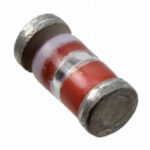 1N5299UR-1/TR
The activity of extra discounts on wholesale prices is in full swing…
Please fill in your contact information and we will send you the latest wholesale price list.





