 ChipApex | Global Electronic Components Supplier
SEARCH
Search Product
Search Post
— IC芯片 | 连接器 | 传感器 | 被动器件 —
Search productSearch post
— IC芯片 | 连接器 | 传感器 | 被动器件 —
Consult the customer manager about the wholesale price.
consultation hotline:86-132-6715-2157
email:[email protected]
Contact the product manager for consultation. One-stop consultation is available.
Do you want a lower wholesale price? Please send us your inquiry and we will reply immediately.
The CMJD4500 TR is a surface mount silicon current limiting diode manufactured by Central Semiconductor Corp. It is designed to maintain a constant current over a wide range of supply voltages. The device features a maximum regulator current of 5.1 mA and a maximum peak operating voltage of 100 V. Key electrical parameters include a maximum limit voltage of 3.7 V, a minimum dynamic impedance of 1.6 kOhms, and a minimum knee impedance of 1.6 kOhms. The component supports a maximum power dissipation of 780 mW and operates within a temperature range of -55°C to +150°C.
Verify the specific ordering suffix against the manufacturer's official documentation to ensure correct packaging configuration. Confirm RoHS compliance status and lead time requirements directly with authorized distributors or the manufacturer prior to procurement. Ensure the part number matches the exact specification sheet for the CMJD4500 series to avoid compatibility issues in design implementation.
Select this component when a stable current source is required for load protection or regulation in compact designs. Consider the 100 V maximum voltage rating and 5.1 mA current limit for appropriate circuit matching. Evaluate the SMD-2 package dimensions for PCB layout constraints and verify thermal management capabilities given the 780 mW power dissipation rating under expected operating conditions.
This part belongs to the CMJD series of current limiting diodes from Central Semiconductor. The series is engineered to provide reliable current regulation in discrete semiconductor applications. The CMJD4500 variant specifically targets surface mount implementations requiring precise current control without complex active components, fitting into broader portfolios of standard and niche discrete devices offered by the manufacturer.
Consult official substitution guides for equivalent current limiting diodes with matching 5.1 mA regulation and 100 V ratings. Verify pinout compatibility and thermal characteristics before replacing. Cross-reference datasheets for impedance profiles to ensure functional parity in existing designs.
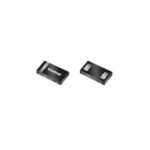 CMJD4500 TR
The activity of extra discounts on wholesale prices is in full swing…
Please fill in your contact information and we will send you the latest wholesale price list.




