ChipApex | Global Electronic Components Supplier
SEARCH
Search Product
Search Post
— IC芯片 | 连接器 | 传感器 | 被动器件 —
Search productSearch post
— IC芯片 | 连接器 | 传感器 | 被动器件 —
Consult the customer manager about the wholesale price.
consultation hotline:86-132-6715-2157
email:[email protected]
Contact the product manager for consultation. One-stop consultation is available.
Do you want a lower wholesale price? Please send us your inquiry and we will reply immediately.
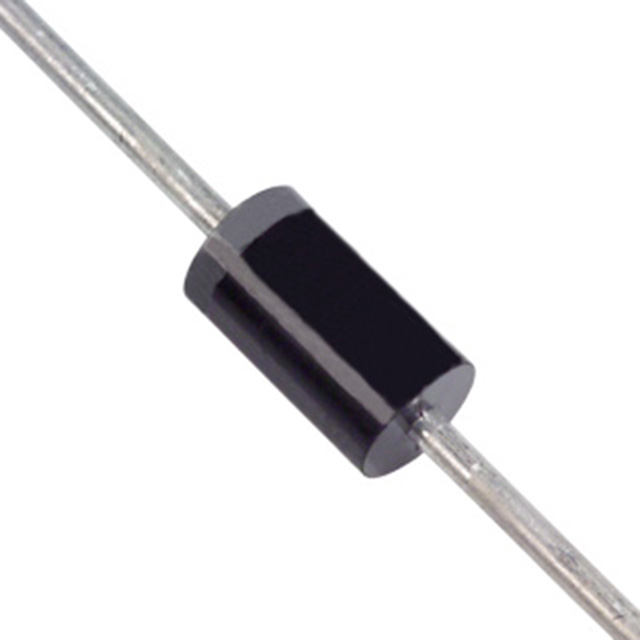
The 1N5401-T is a standard recovery rectifier diode manufactured by Diodes Incorporated in the DO-201AD axial leaded package. It features a maximum repetitive peak reverse voltage of 100 V and an average forward rectified current rating of 3.0 A at 105°C ambient temperature. The device supports a non-repetitive peak forward surge current of 200 A for an 8.3 ms half-sine wave. Electrical characteristics include a typical forward voltage of 1.0 V at 3.0 A, a peak reverse current of 10 µA at 25°C, and a junction-to-ambient thermal resistance of 15 °C/W. Operating and storage temperatures range from -65°C to +150°C.
Verify component authenticity through authorized distributors or direct manufacturer channels. Confirm RoHS compliance status and specific packaging details via official documentation. Ensure procurement sources provide valid traceability records. Check for end-of-life notices as the datasheet indicates this series is not recommended for new designs.
Select this component for general-purpose rectification requiring 100 V blocking capability and 3 A continuous current handling. Consider the DO-201AD package for through-hole mounting requirements. Evaluate thermal management needs based on the specified junction-to-ambient thermal resistance. Verify that the operating temperature range meets the environmental conditions of the target application.
This part belongs to the 1N5400-1N5408 series of 3.0 A silicon rectifiers produced by Diodes Incorporated. The suffix '-T' denotes tape and reel packaging configuration. The series utilizes diffused junction technology and is housed in a molded plastic case with UL 94V-0 flammability classification. These devices are designed for general-purpose applications requiring reliable standard recovery performance.
The datasheet explicitly recommends using the S3A-S3M Series as alternatives. Verify pinout compatibility and electrical parameter equivalence before substitution. Ensure the replacement component meets the same mechanical and thermal requirements.
 1N5401-T
The activity of extra discounts on wholesale prices is in full swing…
Please fill in your contact information and we will send you the latest wholesale price list.