ChipApex | Global Electronic Components Supplier
SEARCH
Search Product
Search Post
— IC芯片 | 连接器 | 传感器 | 被动器件 —
Search productSearch post
— IC芯片 | 连接器 | 传感器 | 被动器件 —
Consult the customer manager about the wholesale price.
consultation hotline:86-132-6715-2157
email:[email protected]
Contact the product manager for consultation. One-stop consultation is available.
Do you want a lower wholesale price? Please send us your inquiry and we will reply immediately.
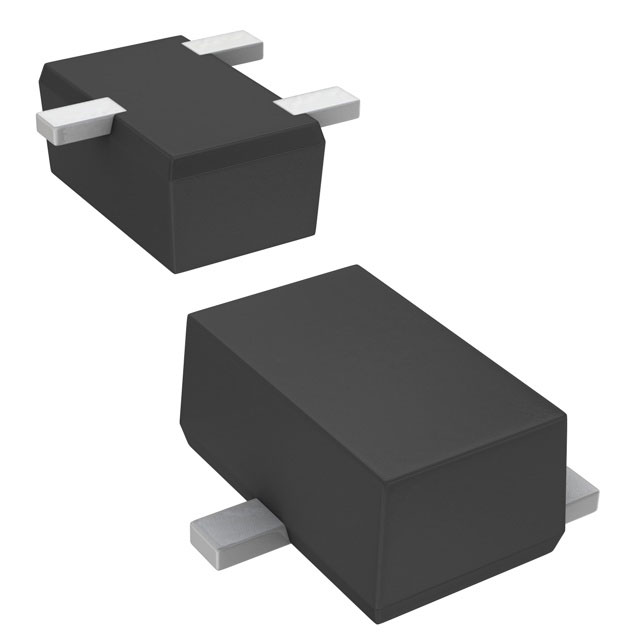
The Panasonic 2SK3539 is a silicon N-channel MOSFET designed for switching applications. It features a built-in gate protection diode and operates within a drain-source voltage of 50 V and a continuous drain current of 100 mA. The device utilizes an SMini3-G1 (EIAJ: SC-70) package, measuring approximately 1.3 mm by 2.1 mm. Key electrical characteristics include a maximum drain-source on-resistance of 15 Ω at VGS = 2.5 V and a forward transfer admittance ranging from 20 to 60 mS. Turn-on and turn-off times are specified at 200 ns under standard test conditions.
Verify the current lifecycle status directly through official Panasonic channels before procurement. The datasheet indicates this component falls under maintenance or discontinued categories. Confirm availability and lead times with authorized distributors. Ensure that the latest product standards match your design requirements prior to finalizing orders.
Select this component for low-voltage switching tasks requiring compact form factors. The 50 V rating and 100 mA current limit define its operational boundaries. Consider the 15 Ω on-resistance for power dissipation calculations in load circuits. Verify compatibility with control logic levels, as threshold voltages vary between 0.9 V and 1.5 V.
This part belongs to the Panasonic small signal silicon MOSFET family. It is engineered for general-purpose switching rather than high-power amplification. The SC-70 package allows for automated surface-mount assembly. It serves as a standard discrete transistor solution for consumer and industrial electronics.
Consult official Panasonic documentation for confirmed substitute part numbers. Cross-referencing requires matching voltage, current, and package specifications. Verify pinout compatibility if replacing in existing layouts.
The integrated gate protection diode safeguards the gate terminal against voltage spikes and electrostatic discharge, enhancing device reliability during switching operations.
The drain-source on-resistance increases as the ambient temperature rises. Designers must account for this thermal coefficient when calculating power dissipation at elevated operating temperatures.
 2SK353900L
The activity of extra discounts on wholesale prices is in full swing…
Please fill in your contact information and we will send you the latest wholesale price list.