 ChipApex | Global Electronic Components Supplier
SEARCH
Search Product
Search Post
— IC芯片 | 连接器 | 传感器 | 被动器件 —
Search productSearch post
— IC芯片 | 连接器 | 传感器 | 被动器件 —
Consult the customer manager about the wholesale price.
consultation hotline:86-132-6715-2157
email:[email protected]
Contact the product manager for consultation. One-stop consultation is available.
Do you want a lower wholesale price? Please send us your inquiry and we will reply immediately.
The Vishay 4N33 is a general-purpose, single-channel photodarlington optocoupler featuring a gallium arsenide infrared LED and a silicon photodarlington sensor. It provides high isolation with an insulation voltage of 5300 Vrms. The device offers a minimum current transfer ratio (CTR) of 500% at a forward current of 10 mA. Key electrical parameters include a collector-emitter voltage of 30V and a maximum forward current of 60mA. It is housed in a standard 6-pin DIP package.
Verify component authenticity through authorized distributors as the 4N33 series has been subject to discontinuance notifications by various manufacturers including Vishay. Confirm specific manufacturing lot dates and RoHS compliance status, as legacy stock may vary in environmental specifications. Ensure that the selected supplier provides valid traceability documentation for quality assurance purposes.
Select this component when high gain is required for low-level signal switching applications. The photodarlington output offers superior sensitivity compared to standard transistor outputs. Consider the slow switching speed inherent to Darlington structures; it is suitable for DC or low-frequency AC signals but not for high-speed data transmission where faster optocouplers are necessary.
The 4N33 belongs to a family of general-purpose photodarlington optocouplers widely used in legacy electronic designs. It is often paired with the 4N32, which features a standard phototransistor output instead of a Darlington pair. This family serves as a foundational component for basic galvanic isolation requirements in power electronics and instrumentation.
Public confirmed substitute part numbers include the Fairchild Semiconductor FOD823 and the ON Semiconductor PC123. These alternatives offer similar pin configurations and electrical characteristics, ensuring compatibility in existing PCB layouts without requiring design modifications.
The current transfer ratio typically ranges from 50% to 600%, with a minimum guaranteed value of 500% at a forward current of 10 mA in many datasheet specifications.
No, the 4N33 is not suitable for high-speed applications due to the slow response time associated with the photodarlington output structure. It is designed for low-frequency or DC isolation tasks.
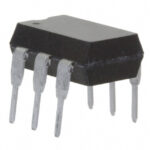 4N33
4N33
The activity of extra discounts on wholesale prices is in full swing…
Please fill in your contact information and we will send you the latest wholesale price list.






