 ChipApex | Global Electronic Components Supplier
SEARCH
Search Product
Search Post
— IC芯片 | 连接器 | 传感器 | 被动器件 —
Search productSearch post
— IC芯片 | 连接器 | 传感器 | 被动器件 —
Consult the customer manager about the wholesale price.
consultation hotline:86-132-6715-2157
email:[email protected]
Contact the product manager for consultation. One-stop consultation is available.
Do you want a lower wholesale price? Please send us your inquiry and we will reply immediately.
The Teridian 73S8010C is a single smart card interface IC compliant with ISO-7816-3 and EMV 4.0 specifications. It interfaces with the host via a fast-mode 400 kbps I2C bus, supporting up to eight parallel devices. The device features an inductor-based DC-DC converter that supplies 3 V or 5 V to the card from a 2.7 V to 3.6 V system supply (VDD), delivering up to 100 mA with over 80% efficiency at 65 mA load. An on-chip oscillator generates the card clock using an external crystal or host clock up to 27 MHz. Protection includes voltage supervisors for VCC and VDD, true over-current detection up to 150 mA, and over-temperature monitoring. The IC offers a power-down mode with typical current of 2 μA and provides auxiliary I/O lines for C4/C8 contacts.
Verify component authenticity through authorized Analog Devices distributors or certified secondary market suppliers. Request original manufacturer datasheets and traceability documentation to confirm part origin. Inspect packaging integrity and pin condition upon receipt. Ensure the specific suffix matches the required package type, as variations exist between SO28 and QFN formats. Confirm compliance with relevant environmental standards if applicable to your manufacturing process.
Select the appropriate package variant based on board space constraints, choosing between the SO28 or 32-QFN options. Ensure the external inductor value meets the 10 μH nominal requirement rated for 400 mA to support the DC-DC converter's performance. Verify that the host controller supports the 400 kbps I2C protocol and can handle the address selection pins for multi-device configurations. Consider the power-down functionality requirements when designing the PWRDN control logic.
Originally developed by Teridian Semiconductor Corporation, this smart card interface IC was later acquired by Maxim Integrated, which is now part of Analog Devices Inc. The 73S8010C belongs to a family of intelligent smart card readers designed to simplify system integration by combining the interface logic, power regulation, and protection circuits into a single component. It serves as a bridge between standard smart cards and low-voltage microcontrollers.
Check for direct cross-references within the Analog Devices portfolio. Evaluate alternative smart card interface ICs from other manufacturers only if they match the I2C interface, voltage range, and current capabilities. Ensure any substitute maintains compatibility with the existing PCB layout, particularly regarding the external inductor and capacitor requirements for the DC-DC converter stage.
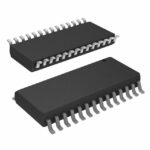 73S8010C-ILR/F
The activity of extra discounts on wholesale prices is in full swing…
Please fill in your contact information and we will send you the latest wholesale price list.







