 ChipApex | Global Electronic Components Supplier
SEARCH
Search Product
Search Post
— IC芯片 | 连接器 | 传感器 | 被动器件 —
Search productSearch post
— IC芯片 | 连接器 | 传感器 | 被动器件 —
Consult the customer manager about the wholesale price.
consultation hotline:86-132-6715-2157
email:[email protected]
Contact the product manager for consultation. One-stop consultation is available.
Do you want a lower wholesale price? Please send us your inquiry and we will reply immediately.
The Teridian 73S8014R is a single smart card interface circuit designed for asynchronous ICC support. It provides full electrical compliance with ISO 7816-3 and EMV 4.0 specifications, supporting both 3V and 5V cards via an internal LDO regulator powered by VPC (4.75V to 5.5V). Digital interfacing operates on VDD (2.7V to 5.5V). The device features a maximum card current of 65mA, over-current detection up to 130mA, and a card clock frequency up to 20MHz. It includes a crystal oscillator or external clock input up to 27MHz, 6kV ESD protection on card pins, and is housed in a 20-pin SO package.
Verify the specific suffix 'ILR/F2' against the manufacturer's official ordering information table to confirm exact packaging type and temperature grade. Confirm availability status as this component may be subject to discontinuation or limited production runs depending on the current manufacturing lifecycle stage.
Select this component when firmware compatibility with existing 8024 designs is required while reducing pin count. Ensure the application supports single I/O asynchronous cards only. Verify that the host processor can provide the necessary digital control signals and that the available power supplies meet the specified VPC and VDD ranges.
The 73S8014R is part of the Teridian 73S80xxR family, derived from the industry-standard 73S8024RN. It is optimized for Set-Top-Box and A/V Conditional Access applications where cost reduction and smaller form factors are prioritized. The device maintains electrical compliance with major smart card standards while simplifying the external component requirements.
The datasheet indicates direct firmware compatibility with all 8024 ICs. Designers migrating from other 8024-type interfaces should verify pinout differences and ensure the target application does not require synchronous card support, which is excluded from this model's capabilities.
The VDD fault threshold can be adjusted using an external resistor network connected to the VDDF_ADJ pin. If left open, it defaults to approximately 2.33V.
The card clock frequency is determined by an external crystal connected to XTALIN/XTALOUT or an external clock signal, divided by ratios selected via CLKDIV1 and CLKDIV2 inputs.
Emergency card deactivation is initiated automatically upon card extraction or detection of faults such as card over-current, VCC undervoltage, or VDD power supply faults.
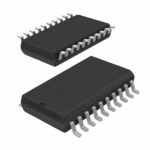 73S8014R-ILR/F2
The activity of extra discounts on wholesale prices is in full swing…
Please fill in your contact information and we will send you the latest wholesale price list.






