 ChipApex | Global Electronic Components Supplier
SEARCH
Search Product
Search Post
— IC芯片 | 连接器 | 传感器 | 被动器件 —
Search productSearch post
— IC芯片 | 连接器 | 传感器 | 被动器件 —
Consult the customer manager about the wholesale price.
consultation hotline:86-132-6715-2157
email:[email protected]
Contact the product manager for consultation. One-stop consultation is available.
Do you want a lower wholesale price? Please send us your inquiry and we will reply immediately.
The 74ABT573AD,118 is an octal D-type transparent latch with 3-State outputs manufactured by NXP USA Inc. It operates on a 4.5V to 5.5V supply within a -40°C to +85°C temperature range. The device features a flow-through pinout in a 20-pin plastic SO package (SOT163-1). Propagation delays from data inputs to outputs range from 2.8ns to 4.8ns at 25°C and up to 5.3ns across the full operating temperature range.
Verify the specific ordering suffix 'AD' corresponds to the 20-pin plastic SO package (SOT163-1) as defined in the Philips/NXP specification. Confirm that the manufacturer designation aligns with current NXP USA Inc. product lines, as historical documentation references Philips Semiconductors. Ensure the component meets the required -40°C to +85°C ambient operating temperature range for your application environment.
Select this component when a high-speed BiCMOS latch with flow-through pinout is required for direct microprocessor interface. It is suitable for applications needing independent control of latching and bus tri-stating. Consider the 2.8ns typical propagation delay and high output drive currents (-32mA/64mA) for driving heavy loads or long traces compared to standard TTL equivalents.
This device belongs to the 74ABT logic family, characterized by high performance and low power dissipation. It is functionally identical to the 74ABT373 but utilizes a flow-through pinout arrangement. This configuration places inputs and outputs on opposite sides of the package, simplifying printed circuit board routing for parallel data transfer applications.
The 74ABT373 serves as the functional equivalent with a non-flow-through pinout. For alternative packages, the 74ABT573A DB (SSOP) and 74ABT573A PW (TSSOP) are available within the same series.
The 74ABT573A is functionally identical to the 74ABT373 but features a flow-through pinout configuration, whereas the 74ABT373 has a different pin arrangement.
The active-Low Output Enable (OE) input controls all eight 3-State buffers independently of the latch operation. When OE is High, the outputs enter a high-impedance state.
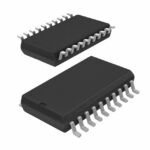 74ABT573AD,118
The activity of extra discounts on wholesale prices is in full swing…
Please fill in your contact information and we will send you the latest wholesale price list.





