 ChipApex | Global Electronic Components Supplier
SEARCH
Search Product
Search Post
— IC芯片 | 连接器 | 传感器 | 被动器件 —
Search productSearch post
— IC芯片 | 连接器 | 传感器 | 被动器件 —
Consult the customer manager about the wholesale price.
consultation hotline:86-132-6715-2157
email:[email protected]
Contact the product manager for consultation. One-stop consultation is available.
Do you want a lower wholesale price? Please send us your inquiry and we will reply immediately.
The Nexperia 74ALVCH16501DGG,11 is an 18-bit universal bus transceiver with 3-state outputs housed in a TSSOP56 (SOT364-1) package. It operates within a supply voltage range of 1.2 V to 3.6 V and supports data flow controlled by output enable, latch enable, and clock inputs for both A-to-B and B-to-A directions. The device features bus hold on all data inputs and IOFF circuitry for partial power-down applications. It complies with JEDEC standards JESD8-7, JESD8-5, and JESD8C/JESD36, and provides ESD protection exceeding 2000 V (HBM) and 1000 V (CDM).
Verify the specific ordering suffix ',11' against official Nexperia documentation to confirm reel/tape packaging specifications, as datasheets may list standard tube packaging. Confirm the component status is active production rather than obsolete or end-of-life before finalizing procurement plans.
Select this component for designs requiring high-density 18-bit data transfer with flexible control over data flow direction and storage states. Ensure the application environment stays within the -40 °C to +85 °C temperature range and utilizes the specified 1.2 V to 3.6 V supply voltage for optimal performance.
This part belongs to the Nexperia ALVCH logic family, designed for low-voltage CMOS applications. It serves as a high-performance solution for wide-bus interfaces, offering speed and power efficiency comparable to older technologies while operating at lower voltages. The TSSOP56 package allows for compact PCB layouts in space-constrained electronic devices.
Direct replacements must match the 18-bit width, ALVCH series characteristics, and TSSOP56 footprint. Verify that any substitute component also includes bus hold inputs and IOFF functionality if these features are critical to the design.
The IOFF circuitry disables the outputs when the device is powered down, preventing potentially damaging backflow current through the device during partial power-down applications.
Data flow from A to B is controlled by the OEAB (output enable), LEAB (latch enable), and CPAB (clock) inputs, allowing operation in transparent, latched, or clocked modes.
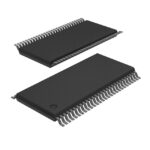 74ALVCH16501DGG,11
The activity of extra discounts on wholesale prices is in full swing…
Please fill in your contact information and we will send you the latest wholesale price list.






