 ChipApex | Global Electronic Components Supplier
SEARCH
Search Product
Search Post
— IC芯片 | 连接器 | 传感器 | 被动器件 —
Search productSearch post
— IC芯片 | 连接器 | 传感器 | 被动器件 —
Consult the customer manager about the wholesale price.
consultation hotline:86-132-6715-2157
email:[email protected]
Contact the product manager for consultation. One-stop consultation is available.
Do you want a lower wholesale price? Please send us your inquiry and we will reply immediately.
The 74ALVT16501DGG,118 is an 18-bit universal bus transceiver manufactured by Nexperia USA Inc. It operates at VCC voltages of 2.5 V and 3.3 V with I/O compatibility up to 5 V. The device features non-inverting 3-state outputs in both send and receive directions. Data flow is controlled by output enable (OEAB/OEBA), latch enable (LEAB/LEBA), and clock (CPAB/CPBA) inputs. It utilizes positive-edge triggered clock inputs for data latching and includes active bus hold circuitry to maintain valid logic levels on unused or floating data inputs.
Verify the specific ordering suffix '118' against the manufacturer's current production status, as standard product lines may undergo discontinuation or packaging changes. Confirm that the TSSOP56 package variant matches the required footprint for PCB layout. Ensure design compliance with the recommended operating conditions regarding supply voltage tolerances and ambient temperature ranges specified in the datasheet.
Select this component when an 18-bit width is required for bidirectional data transmission with registered storage capabilities. It is suitable for designs needing 5 V tolerance on I/O pins while maintaining low power consumption at 2.5 V or 3.3 V operation. Consider the TSSOP56 package constraints and ensure sufficient board space for the 56-lead thin shrink small outline package dimensions.
This device belongs to the 74ALVT series of BiCMOS logic products designed for high-speed applications. It serves as a bridge between different voltage domains, specifically enabling communication between 3.3 V or 2.5 V logic cores and 5 V peripheral buses. The universal transceiver architecture allows flexible configuration for either transparent buffering or registered data storage depending on system timing requirements.
Direct substitutes include the 74ALVCH16501DGGY from Nexperia and variants such as SN74ALVCH16501DGGR from Texas Instruments. Verify pinout compatibility and electrical characteristics before substitution, as logic family variations may impact switching speeds and drive strengths.
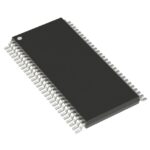 74ALVT16501DGG,118
The activity of extra discounts on wholesale prices is in full swing…
Please fill in your contact information and we will send you the latest wholesale price list.






