 ChipApex | Global Electronic Components Supplier
SEARCH
Search Product
Search Post
— IC芯片 | 连接器 | 传感器 | 被动器件 —
Search productSearch post
— IC芯片 | 连接器 | 传感器 | 被动器件 —
Consult the customer manager about the wholesale price.
consultation hotline:86-132-6715-2157
email:[email protected]
Contact the product manager for consultation. One-stop consultation is available.
Do you want a lower wholesale price? Please send us your inquiry and we will reply immediately.
The 74HCT4511D,653 is a BCD to 7-segment latch/decoder/driver manufactured by Nexperia USA Inc. It features four address inputs (A, B, C, D), a latch enable input (LE), a ripple blanking input (BI), and a lamp test input (LT). The device provides seven segment outputs (a to g) for driving common cathode LED displays. It operates within a supply voltage range of 4.5 V to 5.5 V and supports an operating temperature range of -40°C to +125°C. The component is housed in a 16-SOIC package with surface mount installation.
Verify the specific suffix '653' against the manufacturer's current datasheet to confirm pinout compatibility and RoHS status. Ensure the design utilizes a 4.5V to 5.5V power supply, as this HCT variant requires higher voltage than standard HC logic. Confirm that the 16-SOIC package dimensions match the target PCB footprint before finalizing procurement orders.
Select this component when a TTL-compatible BCD decoder with integrated latching is required for LED indicators. It is suitable for designs needing direct interface with microcontroller BCD outputs without external latch components. Consider the 74HC4511 if a wider 2.0V to 6.0V supply range or CMOS input levels are necessary instead of the HCT TTL levels.
This part belongs to the 74HCT series of high-speed CMOS logic devices from Nexperia. It functions as a specialized decoder within the broader family of digital logic ICs designed for general-purpose computing and display interfacing applications. The device integrates decoding, latching, and driver capabilities into a single package.
When LE is LOW, the segment outputs follow the data on inputs A to D. When LE goes HIGH, the last data present on the inputs is stored in the internal latches, keeping the segment outputs stable regardless of subsequent input changes.
When the LT input is LOW, all segment outputs are forced HIGH, causing all segments of the connected LED display to illuminate simultaneously. This allows for verification of the display functionality independent of the data inputs.
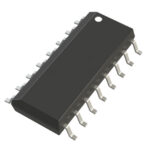 74HCT4511D,653
The activity of extra discounts on wholesale prices is in full swing…
Please fill in your contact information and we will send you the latest wholesale price list.





