 ChipApex | Global Electronic Components Supplier
SEARCH
Search Product
Search Post
— IC芯片 | 连接器 | 传感器 | 被动器件 —
Search productSearch post
— IC芯片 | 连接器 | 传感器 | 被动器件 —
Consult the customer manager about the wholesale price.
consultation hotline:86-132-6715-2157
email:[email protected]
Contact the product manager for consultation. One-stop consultation is available.
Do you want a lower wholesale price? Please send us your inquiry and we will reply immediately.
The Fairchild Semiconductor 74LVTH16374MTD is a low-voltage 16-bit D flip-flop featuring three-state outputs, designed for 3.3V VCC applications with TTL interface capability in 5V environments. It operates within a supply voltage range of 2.7V to 3.6V and supports a maximum propagation delay of 5.2 ns. The device provides high drive strength with output currents of -32 mA (high) and 64 mA (low). Packaged in a 48-TFSOP surface-mount format, it functions reliably across an operating temperature range of -40°C to +85°C.
Verify component authenticity through authorized distribution channels due to the prevalence of counterfeit logic ICs. Confirm that the specific suffix MTD corresponds to the 48-TFSOP package variant required for your PCB footprint. Ensure compliance with RoHS directives if lead-free assembly is mandated by your manufacturing standards. Cross-reference the manufacturer part number against current obsolescence notices to confirm production status before finalizing procurement plans.
Select this component when designing systems requiring 16-bit parallel data latching with high-speed performance at 3.3V logic levels. The TTL-compatible input structure simplifies interfacing with legacy 5V components without additional level shifting circuitry. Consider the 48-TFSOP package dimensions for space-constrained surface-mount designs requiring robust thermal performance and reliable electrical characteristics under varying load conditions.
This device belongs to the LVTH series of low-voltage logic products, bridging the gap between traditional 5V TTL logic and modern 3.3V CMOS technologies. The 74LVTH16374 variant specifically addresses the need for high-density data storage in portable and battery-operated devices where power efficiency is critical yet compatibility with existing 5V infrastructure must be maintained.
The 74LVTH16374MEAX serves as a verified substitute part number offering identical functional specifications and pinout configuration. Verify package compatibility when transitioning between TFSOP and SSOP variants to ensure mechanical fit within the target assembly.
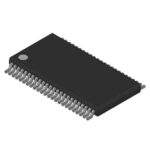 74LVTH16374MTD
The activity of extra discounts on wholesale prices is in full swing…
Please fill in your contact information and we will send you the latest wholesale price list.






