 ChipApex | Global Electronic Components Supplier
SEARCH
Search Product
Search Post
— IC芯片 | 连接器 | 传感器 | 被动器件 —
Search productSearch post
— IC芯片 | 连接器 | 传感器 | 被动器件 —
Consult the customer manager about the wholesale price.
consultation hotline:86-132-6715-2157
email:[email protected]
Contact the product manager for consultation. One-stop consultation is available.
Do you want a lower wholesale price? Please send us your inquiry and we will reply immediately.
The A231 is a general-purpose RF amplifier IC from MACOM Technology Solutions, designed for operation within the 10 MHz to 300 MHz frequency range. This discrete hybrid device utilizes thin film manufacturing processes to ensure accurate performance and high reliability. Key electrical specifications include a noise figure of 1.7 dB and a gain of 26 dB. The component is housed in a TO-8 package, providing a robust solution for applications requiring stable signal amplification across its specified bandwidth.
Verify the specific datasheet revision and exact pinout configuration against your schematic before integration. Confirm that the TO-8 package dimensions align with your PCB footprint requirements. Ensure thermal management strategies are adequate for the operating environment, as performance may vary with temperature. Cross-reference the manufacturer's official documentation for any updates to mechanical drawings or recommended soldering profiles to guarantee assembly quality.
Select this component when a low-noise, moderate-gain amplifier is required for frequencies between 10 MHz and 300 MHz. The TO-8 package offers a traditional form factor suitable for legacy designs or specific shielding requirements. Consider the 1.7 dB noise figure for sensitive reception chains where signal clarity is paramount. Evaluate the 26 dB gain against system loss budgets to determine if additional amplification stages are necessary for optimal link performance.
MACOM Technology Solutions specializes in high-performance analog semiconductor solutions for RF, microwave, and millimeter-wave applications. The A231 represents their expertise in discrete hybrid RF components, leveraging thin-film technology for precision. This product line supports critical infrastructure in telecommunications, industrial, and defense sectors, addressing challenges in signal integrity and network capacity through reliable, high-quality semiconductor devices.
Consult MACOM's official substitution guide for verified equivalent part numbers. Verify compatibility regarding frequency range, gain, noise figure, and package type before replacing the original component.
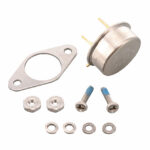 A231
A231
The activity of extra discounts on wholesale prices is in full swing…
Please fill in your contact information and we will send you the latest wholesale price list.