 ChipApex | Global Electronic Components Supplier
SEARCH
Search Product
Search Post
— IC芯片 | 连接器 | 传感器 | 被动器件 —
Search productSearch post
— IC芯片 | 连接器 | 传感器 | 被动器件 —
Consult the customer manager about the wholesale price.
consultation hotline:86-132-6715-2157
email:[email protected]
Contact the product manager for consultation. One-stop consultation is available.
Do you want a lower wholesale price? Please send us your inquiry and we will reply immediately.
The A70-3 is a discrete hybrid RF amplifier designed for high reliability and accurate performance. It utilizes thin film manufacturing processes to ensure stability across its operating range. The device operates within a frequency band of 20 MHz to 250 MHz. Key electrical specifications include a gain of 8.0 dB and a noise figure of 2.8 dB. The unit provides an output power of 40 dBm and features a third-order intercept point of 50 dBm. It requires a supply voltage of 25.0 V and draws a current of 800 mA. The component is housed in a TO-8 package with specific pin assignments.
Verify the specific revision level and lot traceability documentation upon order confirmation. Ensure that the procurement channel provides valid manufacturer certificates of conformity. Confirm that the TO-8 package matches the required pinout configuration for the target application board. Request environmental screening data if MIL-STD-883 compliance is mandated for the project requirements.
Select this component when broadband amplification between 20 MHz and 250 MHz is required with high linearity. The TO-8 hermetic package is suitable for harsh environments where standard surface-mount options are insufficient. Consider the 25V supply requirement and associated power dissipation in the thermal design phase. Evaluate the need for cascading stages based on the available gain and noise figure specifications.
The A70-3 belongs to MACOM's family of discrete hybrid RF amplifiers. These components are engineered for defense and aerospace sectors requiring long-term availability and strict performance tolerances. The series typically includes variants like the SMA70-3, which shares similar functional characteristics but may differ in package or mounting style. This product line emphasizes robustness over miniaturization.
The SMA70-3 is a related variant within the same product family. Verify mechanical footprint compatibility before substitution. Check if the specific pin assignment differences affect the circuit layout. Ensure that the electrical parameters remain within acceptable limits for the existing system design.
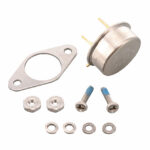 A70-3
A70-3
The activity of extra discounts on wholesale prices is in full swing…
Please fill in your contact information and we will send you the latest wholesale price list.







