 ChipApex | Global Electronic Components Supplier

SEARCH
Search Product
Search Post
— IC芯片 | 连接器 | 传感器 | 被动器件 —
Search productSearch post
— IC芯片 | 连接器 | 传感器 | 被动器件 —
Consult the customer manager about the wholesale price.
consultation hotline:86-132-6715-2157
email:[email protected]
Contact the product manager for consultation. One-stop consultation is available.
Do you want a lower wholesale price? Please send us your inquiry and we will reply immediately.
The AD261BND-0 is a high-speed digital isolator from Analog Devices, designed to isolate five digital control signals between a microcontroller and field I/O components. It utilizes magnetic coupling technology to provide electrical isolation with a rated insulation voltage of 3500 Vrms. The device operates on a single 5 V power supply and features a minimum logic signal bandwidth of 20 MHz per channel. It offers a propagation delay of 14 ns and maintains waveform edge transmission symmetry within ±1 ns. The component supports unidirectional data flow and includes two enable pins for output three-state functionality. It is housed in a 22-pin PDIP package and is rated for operation over an extended temperature range.
Verify the specific suffix designation carefully, as the AD261 series offers six distinct I/O configurations. Confirm that the selected variant matches the required input-to-output pin mapping for the design. Check current availability status as older revisions may have limited stock or discontinuation notices. Ensure compatibility with the 22-pin DIP footprint during PCB layout finalization.
Select this component when high-speed isolation is required for multiple digital channels without the latency associated with optocouplers. The low propagation delay and tight symmetry make it suitable for PWM applications. Consider the 3500 Vrms isolation rating for safety compliance in industrial environments. Verify that the 5 V supply requirement aligns with the target system voltage levels.
The AD261 belongs to Analog Devices' family of high-speed logic isolators. It serves as a direct replacement for up to five discrete opto-isolators, reducing board space and assembly complexity. The device integrates both transmit and receive circuits on a single chip, offering a compact solution for robust digital communication across isolation barriers in noisy industrial settings.
Public confirmed substitute part numbers are not available in the provided documentation. Designers should consult official Analog Devices resources for updated lifecycle status and potential next-generation replacements.
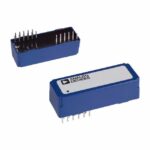 AD261BND-0

The activity of extra discounts on wholesale prices is in full swing…
Please fill in your contact information and we will send you the latest wholesale price list.





