 ChipApex | Global Electronic Components Supplier
SEARCH
Search Product
Search Post
— IC芯片 | 连接器 | 传感器 | 被动器件 —
Search productSearch post
— IC芯片 | 连接器 | 传感器 | 被动器件 —
Consult the customer manager about the wholesale price.
consultation hotline:86-132-6715-2157
email:[email protected]
Contact the product manager for consultation. One-stop consultation is available.
Do you want a lower wholesale price? Please send us your inquiry and we will reply immediately.
The AD595CD is a monolithic thermocouple amplifier and cold junction compensator designed for Type K inputs. It integrates an ice point reference with a precalibrated amplifier to produce a high-level output of 10 mV/°C directly from the thermocouple signal. The device features laser wafer trimming for calibration accuracy, a built-in thermocouple failure alarm with TTL drive capability, and flexible pin-strapping options for setpoint control or standalone Celsius transducer operation. It operates on a wide power supply range from +5 V to dual supplies spanning 30 V.
Verify the specific suffix 'CD' corresponds to the Cerdip (Q-14) package option as listed in the datasheet. Confirm the component grade matches the required calibration accuracy specifications for your application. Ensure the ordering information aligns with Analog Devices Inc. manufacturing standards. Cross-reference the part number with official distributor catalogs to confirm availability and authenticity before procurement.
Select the AD595CD specifically for applications involving Type K (chromel-alumel) thermocouples. The device is pretrimmed for these inputs, offering higher accuracy than generic amplifiers. Consider the wide supply voltage range and low power consumption for battery-operated or remote sites. Verify that the hermetically sealed ceramic package meets environmental requirements for the installation site.
The AD595CD belongs to the AD594/AD595 family of monolithic thermocouple amplifiers. While the AD594 is calibrated for Type J thermocouples, the AD595 is laser trimmed for Type K inputs. Both devices share identical functional architectures, including integrated cold junction compensation and alarm outputs, differing primarily in their gain settings and calibration offsets to match specific thermocouple characteristics.
The AD594CD serves as a functional substitute within the same family but is calibrated for Type J thermocouples rather than Type K. Direct replacement requires recalibration or acceptance of Type K measurement errors. No other direct cross-model replacements are documented in the provided source material.
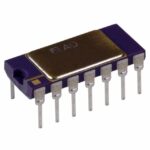 AD595CD
The activity of extra discounts on wholesale prices is in full swing…
Please fill in your contact information and we will send you the latest wholesale price list.





