 ChipApex | Global Electronic Components Supplier
SEARCH
Search Product
Search Post
— IC芯片 | 连接器 | 传感器 | 被动器件 —
Search productSearch post
— IC芯片 | 连接器 | 传感器 | 被动器件 —
Consult the customer manager about the wholesale price.
consultation hotline:86-132-6715-2157
email:[email protected]
Contact the product manager for consultation. One-stop consultation is available.
Do you want a lower wholesale price? Please send us your inquiry and we will reply immediately.
The AD6655ABCPZ-150 is a mixed-signal intermediate frequency (IF) diversity receiver manufactured by Analog Devices Inc. It integrates dual 14-bit analog-to-digital converters (ADCs) operating at a maximum sampling rate of 150 MSPS. The device features a wideband digital downconverter (DDC) with decimation filters and a 32-bit complex numerically controlled oscillator (NCO). It supports IF input frequencies up to 70 MHz when sampled at 150 MSPS. Power specifications include a 1.8 V analog supply and CMOS or LVDS output interfaces. The component is housed in a 64-lead LFCSP package and operates within a temperature range of -40°C to +85°C.
Verify the specific suffix '150' to confirm the 150 MSPS sampling rate variant, as other suffixes like '80', '105', or '125' denote different performance tiers. Confirm RoHS compliance status through official manufacturer documentation prior to integration. Ensure the LFCSP-64 footprint matches the design layout exactly. Check for current production status updates, as availability may vary by region.
Select this part when a high-resolution, low-power IF receiver with integrated digital processing is required. The 150 MSPS speed suits applications demanding higher instantaneous bandwidth compared to lower-speed variants. Evaluate power consumption against system constraints, noting the 1.8 V analog supply requirement. Consider the small form factor of the LFCSP package for space-constrained designs.
This component belongs to the AD6655 family of IF diversity receivers from Analog Devices. The family shares a common architecture but varies in maximum sampling rates, indicated by suffixes such as -80, -105, -125, and -150. The AD6655 series is designed for cost-effective, compact wireless communication solutions requiring high dynamic range and digital flexibility.
Direct substitutes within the same family include AD6655ABCPZ-80, AD6655ABCPZ-105, and AD6655ABCPZ-125, which offer lower sampling rates. Verify pin compatibility and software configuration differences when migrating between these variants.
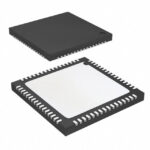 AD6655ABCPZ-150
The activity of extra discounts on wholesale prices is in full swing…
Please fill in your contact information and we will send you the latest wholesale price list.





