 ChipApex | Global Electronic Components Supplier
SEARCH
Search Product
Search Post
— IC芯片 | 连接器 | 传感器 | 被动器件 —
Search productSearch post
— IC芯片 | 连接器 | 传感器 | 被动器件 —
Consult the customer manager about the wholesale price.
consultation hotline:86-132-6715-2157
email:[email protected]
Contact the product manager for consultation. One-stop consultation is available.
Do you want a lower wholesale price? Please send us your inquiry and we will reply immediately.
The AD7306ANZ is a monolithic RS-232/RS-422 transceiver operating from a single +5 V supply. It integrates two RS-232 drivers, one RS-422 driver, one RS-232 receiver, and one configurable receiver. The internal charge pump generates ±10 V levels using four 0.1 μF capacitors. Electrical specifications include an RS-232 data rate up to 100 kHz and an RS-422 rate up to 5 MHz. The device operates within a temperature range of –40°C to +85°C.
Verify the specific package variant when ordering, as the AD7306 series includes both DIP and SOIC options. Confirm that the selected part corresponds to the industrial temperature grade required for the application environment. Ensure compatibility with the 24-pin footprint during PCB layout review. Cross-reference the manufacturer's ordering guide to confirm RoHS compliance status for the specific suffix.
Select this component when a design requires simultaneous support for single-ended RS-232 and differential RS-422 signaling without consuming multiple IC footprints. The internal voltage generation simplifies power supply requirements by eliminating the need for external bipolar rails. Consider the low skew characteristics of the RS-422 driver if tight system timing specifications are critical for high-speed data transmission.
The AD7306 belongs to Analog Devices' line of serial interface transceivers designed for mixed-standard communication environments. It utilizes BiCMOS technology to achieve low power consumption while maintaining high-speed performance. The device serves as a bridge between TTL logic levels and standard EIA signal levels, facilitating integration in systems requiring dual protocol support.
Public documentation confirms the AD7306ARZ as a direct functional substitute offering identical electrical characteristics in a surface-mount SOIC package. Both parts share the same industrial temperature range and pinout configuration. Designers must verify mechanical footprint differences when transitioning between the plastic DIP and SOIC variants.
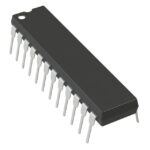 AD7306ANZ
The activity of extra discounts on wholesale prices is in full swing…
Please fill in your contact information and we will send you the latest wholesale price list.





