 ChipApex | Global Electronic Components Supplier
SEARCH
Search Product
Search Post
— IC芯片 | 连接器 | 传感器 | 被动器件 —
Search productSearch post
— IC芯片 | 连接器 | 传感器 | 被动器件 —
Consult the customer manager about the wholesale price.
consultation hotline:86-132-6715-2157
email:[email protected]
Contact the product manager for consultation. One-stop consultation is available.
Do you want a lower wholesale price? Please send us your inquiry and we will reply immediately.
The AD8075ARU is a high-speed triple video buffer with a fixed gain of +2, manufactured by Analog Devices Inc. It operates on dual ±5 V supplies and features a –3 dB full signal bandwidth exceeding 450 MHz, reaching 600 MHz at 200 mV p-p output. The device exhibits a slew rate of 1350 V/µs and a fast settling time of 4 ns. Key performance metrics include 0.01% differential gain error, 0.01° differential phase error, and 0.1 dB gain flatness up to 50 MHz. It offers superior isolation with all-hostile crosstalk better than –80 dB at 10 MHz and OFF isolation better than 90 dB. Quiescent current is less than 30 mA.
Verify the specific ordering suffix when purchasing. The base part number AD8075ARU corresponds to the standard plastic TSSOP package. Suffixes such as Z indicate RoHS compliance, while REEL or REEL7 designations specify tape-and-reel packaging quantities. Confirm that the required package option matches the intended PCB footprint and assembly process before finalizing procurement orders.
Select the AD8075ARU when a fixed voltage gain of +2 is required for triple-channel video applications. This component is distinct from the AD8074, which provides unity gain (G = +1). Ensure the design supports dual ±5 V power supplies and utilizes a 16-lead TSSOP footprint. Consider the fast settle time and high bandwidth requirements for high-resolution display driving tasks where minimal signal distortion is critical.
The AD8075ARU belongs to the AD8074/AD8075 family of high-speed triple video buffers produced by Analog Devices Inc. These devices are engineered for demanding video processing environments requiring precise signal integrity. The AD8075 variant specifically addresses applications necessitating a gain of two, complementing the unity-gain AD8074 within the same product line.
The AD8074 serves as a functional alternative within the same family but provides unity gain (G = +1) instead of the AD8075's gain of +2. Designers must account for this difference in amplification factor when substituting components.
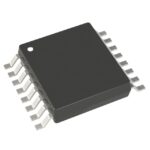 AD8075ARU
The activity of extra discounts on wholesale prices is in full swing…
Please fill in your contact information and we will send you the latest wholesale price list.





