 ChipApex | Global Electronic Components Supplier
SEARCH
Search Product
Search Post
— IC芯片 | 连接器 | 传感器 | 被动器件 —
Search productSearch post
— IC芯片 | 连接器 | 传感器 | 被动器件 —
Consult the customer manager about the wholesale price.
consultation hotline:86-132-6715-2157
email:[email protected]
Contact the product manager for consultation. One-stop consultation is available.
Do you want a lower wholesale price? Please send us your inquiry and we will reply immediately.
The ADG2128BCPZ-REEL7 is an I²C-compatible CMOS analog crosspoint switch array featuring a configuration of eight columns by twelve rows, providing a total of 96 independent bidirectional signal channels. The device supports standard, fast, and high-speed (3.4 MHz) I²C interfaces for control. It operates with dual ±5 V or single +12 V supplies, ensuring full specification across the industrial temperature range of −40°C to +85°C. Key electrical parameters include a maximum on-resistance of 35 Ω, low quiescent current below 20 µA, and a bandwidth up to 300 MHz. The component is housed in a compact 32-lead LFCSP package measuring 5 mm × 5 mm.
Verify the specific suffix against the manufacturer's ordering guide to confirm the exact operating temperature range and I²C speed capabilities. Ensure the supply chain documentation matches the required automotive qualification standards if applicable. Confirm that the reel packaging aligns with automated assembly requirements.
Select this component when a high-density matrix of 96 bidirectional switches is required within a small footprint. Consider the B version for standard industrial applications requiring operation between −40°C and +85°C. Evaluate the need for high-speed I²C communication, noting that only specific model variants support the 3.4 MHz interface option.
This part belongs to the ADG2128 series of analog crosspoint switches manufactured by Analog Devices. The series is designed for applications requiring flexible signal routing in compact spaces. The BC designation indicates the specific temperature grade and package variant suitable for industrial environments.
Direct replacements must match the 8x12 matrix size and I²C control interface. Verify pin compatibility with the 32-lead LFCSP package. Check if alternative models support the same voltage ranges and bandwidth specifications.
Each switch is addressed individually through the I²C-compatible serial interface using a 24-bit write command that specifies the row and column coordinates.
The LDSW bit enables simultaneous updates of multiple switches, allowing them to change state synchronously rather than sequentially during register writes.
Yes, the array is fully bidirectional, allowing any X line or Y line to be configured as either an input or an output depending on the application requirements.
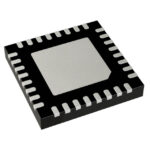 ADG2128BCPZ-REEL7
The activity of extra discounts on wholesale prices is in full swing…
Please fill in your contact information and we will send you the latest wholesale price list.





