 ChipApex | Global Electronic Components Supplier
SEARCH
Search Product
Search Post
— IC芯片 | 连接器 | 传感器 | 被动器件 —
Search productSearch post
— IC芯片 | 连接器 | 传感器 | 被动器件 —
Consult the customer manager about the wholesale price.
consultation hotline:86-132-6715-2157
email:[email protected]
Contact the product manager for consultation. One-stop consultation is available.
Do you want a lower wholesale price? Please send us your inquiry and we will reply immediately.
The ADG751BRT-REEL is a CMOS, low voltage RF/Video SPST switch manufactured by Analog Devices Inc. It operates on a single supply ranging from +1.8 V to +5.5 V and features a T-switch configuration for high off isolation of -75 dB at 100 MHz. The device provides a -3 dB signal bandwidth of 300 MHz with typical on-resistance of 15 Ω. Switching times are typically 9 ns (tON) and 3 ns (tOFF). Power consumption is typically less than 0.01 mW. It is housed in a 6-lead SOT-23 package.
Verify the specific grade (A or B) required for your application, as leakage and on-resistance specifications vary between grades. Confirm that the 6-lead SOT-23 package aligns with your PCB footprint constraints. Ensure proper ESD precautions are taken during handling due to the sensitivity of the CMOS structure. Check for RoHS compliance if environmental regulations apply to your manufacturing process.
Select this component when a single-pole single-throw switch with high isolation and wide bandwidth is needed. Consider the A Grade for lower on-resistance and the B Grade for potentially different leakage characteristics depending on the operating temperature range. Ensure the supply voltage falls within the 1.8 V to 5.5 V range. Verify that the digital input voltage levels match your system's logic family requirements.
The ADG751 is part of Analog Devices' low voltage CMOS switch family. It is designed for applications requiring fast switching and low power consumption. The BRT suffix indicates the 6-lead SOT-23 package option. This component serves as a relay replacement and is suitable for sample-and-hold systems where low charge injection is beneficial.
Direct substitutes include other ADG751 variants such as ADG751ARTZ-REEL7 or ADG751ARMZ. Cross-brand replacements should be evaluated based on pin compatibility, on-resistance, and bandwidth specifications. Ensure any substitute maintains the T-switch architecture for comparable off-isolation performance.
The ADG751 supports a continuous current of 30 mA through the source or drain terminals.
The T-switch configuration improves off-isolation by providing a signal path to ground for unwanted signals through the shunt switch when the series switches are open.
Yes, its low power consumption (typically <0.01 mW) and operation down to 1.8 V make it ideal for battery-powered portable instruments.
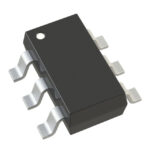 ADG751BRT-REEL
The activity of extra discounts on wholesale prices is in full swing…
Please fill in your contact information and we will send you the latest wholesale price list.





