 ChipApex | Global Electronic Components Supplier
SEARCH
Search Product
Search Post
— IC芯片 | 连接器 | 传感器 | 被动器件 —
Search productSearch post
— IC芯片 | 连接器 | 传感器 | 被动器件 —
Consult the customer manager about the wholesale price.
consultation hotline:86-132-6715-2157
email:[email protected]
Contact the product manager for consultation. One-stop consultation is available.
Do you want a lower wholesale price? Please send us your inquiry and we will reply immediately.
The ADIN1300CCPZ is a low power, single port Gigabit Ethernet transceiver designed for industrial applications. It supports 10BASE-Te, 100BASE-TX, and 1000BASE-T standards with MII, RMII, and RGMII interfaces. Key electrical parameters include supply voltages of 0.9 V (DVDD), 1.8 V/2.5 V/3.3 V (VDDIO), and 3.3 V (AVDD). Latency at 1000BASE-T via RGMII is typically 68 ns transmit and 226 ns receive. Power consumption is 330 mW at 1000BASE-T and 140 mW at 100BASE-TX.
Verify the specific ordering suffix against the manufacturer's current datasheet to confirm package type and temperature range. Confirm availability status as distribution channels may report limited stock or discontinuation notices. Ensure the component meets RoHS compliance requirements for your target market. Cross-reference the manufacturer part number with authorized distributors to validate authenticity and traceability.
Select this device for designs requiring minimal network cycle times in line or ring topologies. The integrated PHY core reduces external component count compared to discrete solutions. Consider the VDDIO flexibility when interfacing with various MAC controller voltage levels. Evaluate thermal dissipation capabilities given the sealed enclosures typical in industrial environments.
The ADIN1300 belongs to Analog Devices' Chronous industrial Ethernet portfolio. It complements lower-speed variants like the ADIN1200 by offering Gigabit throughput. The device integrates analog front-end circuitry, clock buffering, and management logic into a compact 40-lead LFCSP package suitable for space-constrained industrial modules.
Public documentation confirms the ADIN1200 as a functional alternative for 10/100 Mbps applications within the same family. Hardware and software interfaces remain identical between these models, facilitating pin-compatible upgrades where Gigabit speed is not required. Verify that the reduced data rate of the substitute meets system bandwidth requirements.
The device includes built-in cable diagnostics featuring Time Domain Reflectometry (TDR) and signal analysis to detect cable faults, polarity inversion, and pair swaps without external tools.
The ADIN1300 supports MII, RMII, and RGMII interfaces. For RMII operation, an external 50 MHz clock reference is required, while RGMII allows for programmable internal timing delays.
Yes, the ADIN1300 supports Start of Packet Detection specifically designed for IEEE 1588 Precision Time Protocol (PTP) timestamping to enable high-precision synchronization.
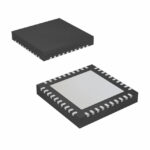 ADIN1300CCPZ
The activity of extra discounts on wholesale prices is in full swing…
Please fill in your contact information and we will send you the latest wholesale price list.





